As concrete and coatings professionals at GCM Best Services, we know that not all garage floors are created equal—especially when heavy equipment enters the picture. Storing, maintaining, and moving weighty vehicles or machinery brings unique challenges that go beyond standard garage use. We’ll share our deep experience with concrete, epoxy, polyaspartic, and protective systems designed for the demands of Central Florida, keeping local soil, weather, and usage in mind.
From preparing surfaces to choosing the right finish, proper installation and specification can mean years of performance—or a floor riddled with cracks and failures. Whether you’re a contractor, collector, or business owner, we’ve got the information you need to extend the service life and safety of your high-load garage with coatings that perform as hard as you do.
Garage floors don’t just need to look good—they need to last under pressure.
Why heavy equipment storage needs specialized garage coatings
Heavy equipment—think trucks, industrial lifts, large vehicles, or professional tools—brings weight, movement, and sometimes chemicals that standard garage coatings can’t handle. Standard DIY paints or thin “store-bought” epoxies often fail because they aren’t built for:
- Concentrated point loads (tires, jacks, equipment feet)
- Friction from turning wheels or dragging implements
- Exposure to oils, solvents, and harsh cleaning products
- Thermal shock from hot tires or rapid temperature shifts
We have seen firsthand how quickly floors can chip, peel, or develop surface damage when the wrong system is used. That’s why we always guide clients toward solutions engineered for Florida’s combination of weather, soils, and heavy-use needs.
Understanding the substrate: Why your concrete base matters
No coating will last long if the base concrete itself is weak, cracked, or sandy. For facilities across Orlando and Central Florida, soil movement and drainage are recurring problems that we address at every job.
- Concrete must be poured over a well-compacted 6–8″ sub-base
- Minimum 3,000–4,000 PSI compressive strength mix is recommended for heavy loading
- Proper rebar or mesh reinforcement minimizes cracking and movement
- Expansion and control joints help absorb movement and allow for thermal expansion
For more details on preparing concrete in Florida’s unique conditions, check our concrete project gallery or read our advice on preventing cracks in concrete driveways and patios.
Choosing the right coating system: Epoxy, polyaspartic, and more
Surface coating materials are not all alike—and that matters even more with heavy equipment. We’ve tested and installed many over the years, but for heavy-duty applications, there are a few standouts:
Epoxy coatings for garages
Epoxy is a tried-and-true performer for demanding environments. In fact, Cornell University’s College of Veterinary Medicine recommends epoxy flooring for traction and durability in animal holding areas—places just as tough as a busy commercial garage. Here’s why:
- 100% solids epoxy provides thick, seamless coverage with outstanding chemical and abrasion resistance
- Customizable slip resistance (additives, texture, or broadcast flake)
- Handles hot tire loads and wheel movement without softening
- Excellent adhesion—if surface is prepared properly
Epoxy coatings last longer and resist more damage than traditional paints or thinner coatings in demanding garage settings.
Polyaspartic and polyurea coatings
Where fast return-to-service is needed, polyaspartic and polyurea systems come into play. These coatings cure quickly (sometimes in hours), remain UV-resistant, and have high impact and chemical tolerance. They can be used as a standalone floor or as a topcoat over epoxy for even greater resistance to tire marks or sunlight-related fading.
Concrete densifiers and sealers
For clients who need some extra strength but require a thinner, less slippery surface, penetrating sealers, and densifiers harden the top few millimeters of concrete. These don’t add as much thickness or chemical resistance as resinous coatings, but offer value when surface appearance isn’t the priority—yet durability is needed.
Coating thickness: Why it matters (and how to get it right)
One of the biggest mistakes we see is coatings applied too thin—or sometimes too thick. The proper “build” of a floor system directly affects how long it lasts, and how well it stands up to abuse. A 2023 study in the journal Materials compared the performance of epoxy coatings at different thicknesses. It found that when a coating is too thin, you lose both corrosion protection and resistance to physical damage. If it’s too thick, you risk poor adhesion and unnecessary cost. This research stresses the need for experienced, precise installation.
Get the thickness wrong, and the whole system can fail.
- For garages used with trucks, heavy vehicles, or industrial tools, we recommend a dry film build of at least 80-120 mils (2-3 mm) for epoxy-based systems.
- Flake systems (broadcast to refusal) add toughness and cover up minor slab imperfections
- Slip-resistant aggregates can be selected based on your equipment (do you have rubber, steel, or plastic wheels?)
On our Florida projects, like at GCM Best Services, we always scope and specify the correct thickness based on what the space is really used for.
The role of surface prep: Why preparation is everything
Ask any coatings pro what matters most and you’ll get this answer:
Surface preparation is the single key to long-lasting floor coatings.
If concrete isn’t cleaned, degreased, and mechanically profiled, even the best coatings will peel. Here’s what our process looks like:
- Moisture vapor testing (to avoid bubbling or delamination later)
- Crack and spall repair (with epoxy patch compounds or polyurethane fillers)
- Shot-blasting or diamond grinding to create a rough “profile” for new coating to grip
- Careful removal of old adhesives or paints
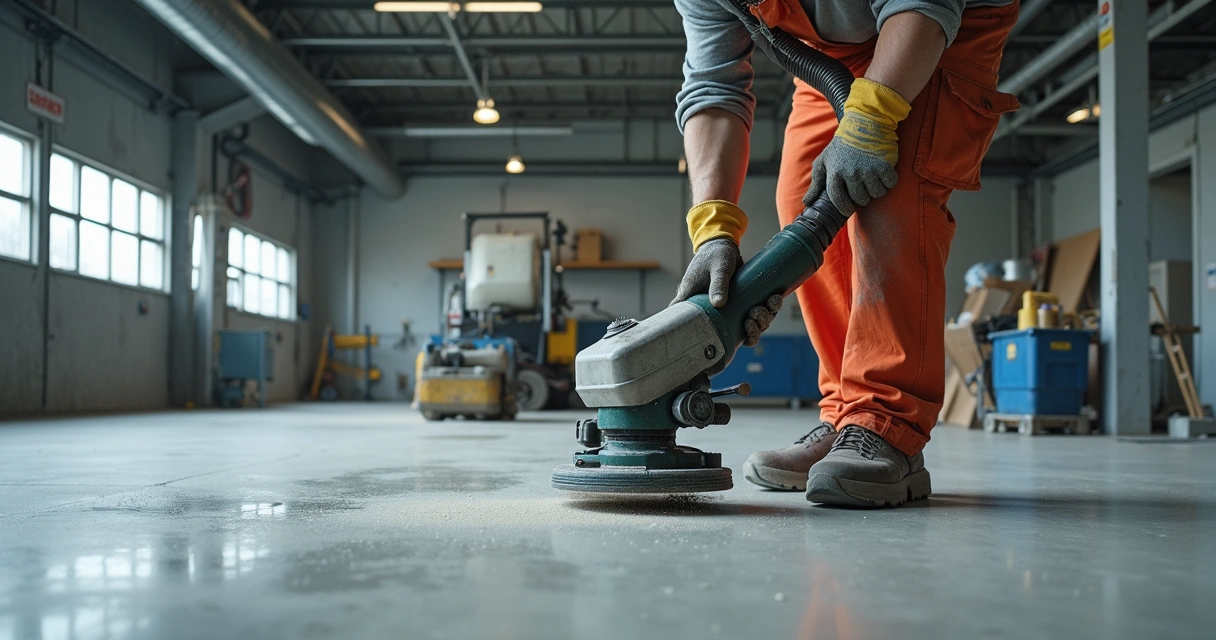
In our Central Florida work, humidity and moisture intrusion are frequent issues. If concrete absorbs too much water or isn’t dry enough before coating, blisters or bubbles often form beneath the surface—a costly fix. No step in preparation can be skipped if you want proper long-term results.
Drainage and joint details matter in Florida garages
Orlando’s subtropical climate can bring flooding, standing water, and sudden storms. Heavy equipment garages often have floor drains, sloped entries, or ramps. We plan drainage as part of every job, making sure water runs away from storage areas, not toward them.
- Joints must be caulked with high-performance, flexible fillers to avoid edge chipping
- High points and slopes are planned early to keep water off your coated floors
- Drains and sumps are integrated into the coating system to prevent leaks around penetrations
If you’re curious about best drainage and slab prep practices, this article on driveway and patio paving covers much of what we also apply to garage floors.
Customizations for equipment-specific demands
No two heavy equipment facilities are exactly alike. We always start with an on-site assessment to see what types of machines are used, how they’re moved, cleaned, or serviced, and what kinds of chemical or fluid exposure are routine. Some common options include:
- Upgraded slip resistance for wet ramps or mechanics’ bays
- Acid, oil, or fuel-resistant topcoats if you service vehicles or machines regularly
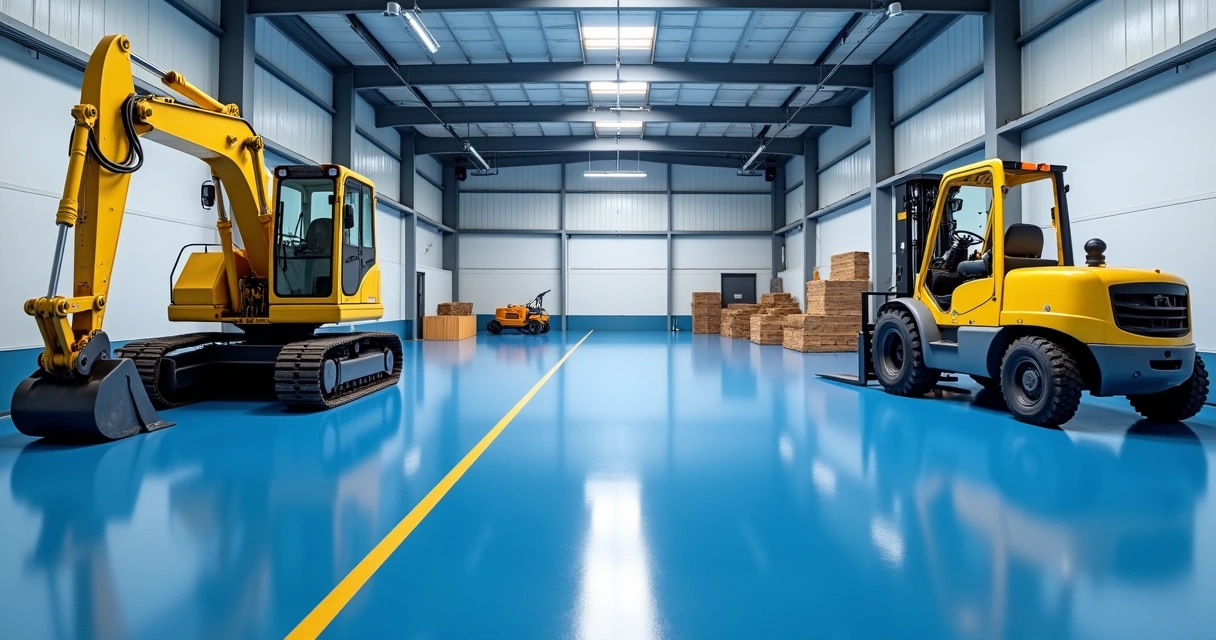
- Color-coded zones for parking, maintenance, or storage (improves both safety and organization)
- Seamless wall-to-floor “coves” for easy spill cleanup
We often install these in settings from local fleet garages to hobby shops. It’s all about matching the system to the real use and making maintenance easier for years to come.
Installation steps for maximum service life
We don’t believe in “just slapping down some paint.” Here’s our typical step-by-step approach for a garage receiving heavy equipment:
- On-site evaluation of existing concrete, moisture content, and structural soundness
- Mechanical prep: Shot-blasting and grinding for profile
- Crack and spall repairs, joint cleaning, and resizing as needed
- Primer application or moisture mitigation if required
- Epoxy basecoat installation at engineered thickness, checking for coverage and edges
- Broadcast of flake or quartz for extra strength and slip resistance
- Intermediate clear coats for build and adhesion
- Polyaspartic or wear-resistant topcoat for chemical resistance and UV stability
- Final inspection, line markings, and user walk-through with cleaning/maintenance instructions
We can adjust for night work or rapid turnarounds. Written warranties and a photo history are always provided.
For a more detailed discussion of installation process and the warranty approach, our team describes this in our guide to choosing a concrete company in Orlando, FL.
Common issues and how to prevent them
In our years of resolving coating failures, we’ve seen a handful of repeat offenders—mistakes that always seem to return. Here’s our shortlist and the reliable ways we solve them:
- Peeling or bubbling: Nearly always due to improper cleaning, lingering grease, or trapped moisture. Our thorough prep solves this.
- Wear through the coating: Low coating thickness or thin paint can’t stand up to tire scuffing or point loads. We always specify build and reinforce high-traffic areas.
- Cracks telegraphing through: Unaddressed slab cracks will eventually ruin a new floor. Our epoxy/mortar repair and joint detailing prevents this.
- Staining, fading, or yellowing: Choosing the right topcoat—UV-resistant polyaspartic or aliphatic urethanes—keeps floors looking good even after years of sun and spills.
Maintaining your coated floor for long-term performance
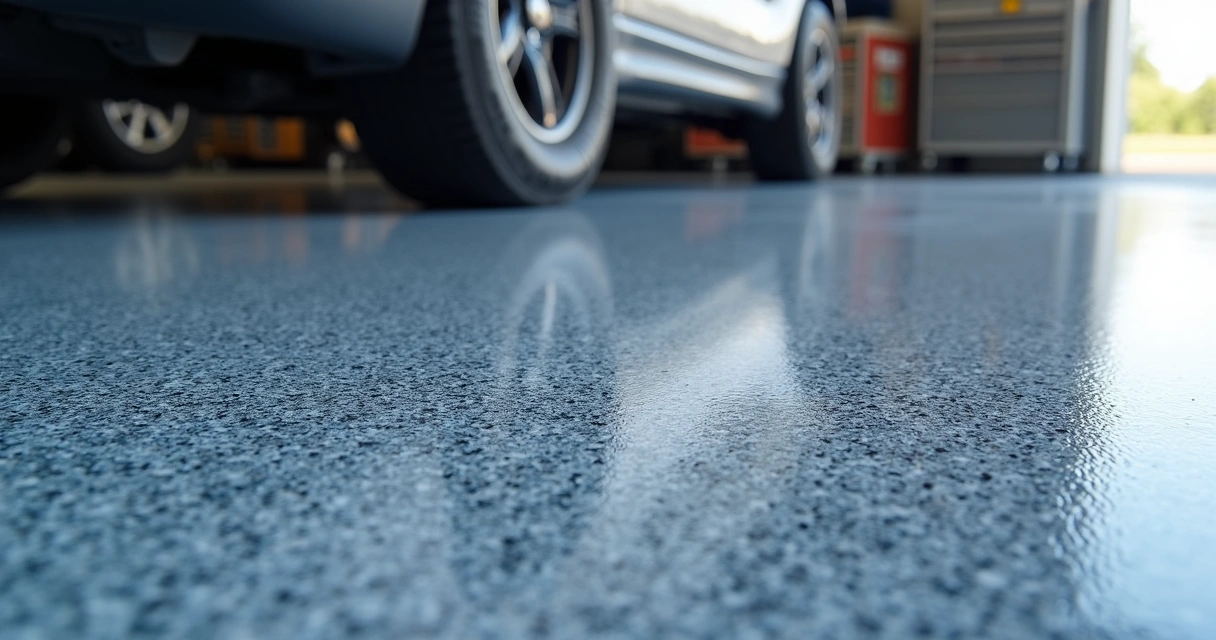
A professionally installed garage coating will outlast paints or sealers, but proper cleaning and basic care matter for preserving lifespan and safety. We suggest:
- Sweeping and mopping away sand or loose grit to prevent abrasion
- Using non-abrasive, neutral pH cleaners
- Quickly cleaning up oil, hydraulic fluid, or battery acid to avoid staining
- Yearly inspection of joints and edges—reseal as needed
- No dragging sharp metal implements across the floor
We give each GCM Best Services client a maintenance guide and keep maintenance simple so you can focus on your business, not continuous repairs.
Real-world use cases: What our Central Florida clients achieve
We see equipment storage needs everywhere: Commercial service fleets, construction yards, government vehicle depots, and even home workshops with large tool cabinets or classic car restorations. Each project teaches us something new.
- One client had issues with water collecting at the garage entry—new drainage planning and slope in the coating system fixed this permanently.
- An industrial warehouse required color-zoned parking for forklifts; our system included orange and yellow epoxy lines for safe navigation.
- Several home workshops in the Orlando area needed high-gloss floors, but worried about slippery surfaces: custom flake blends and slip-resistant media solved this, blending function with appearance.
Every floor is different, but the right system always comes from understanding the equipment, environment, and future growth. We take pride in long-term solutions, not quick fixes.
Our promise: Transparency, communication, and results
With each project, we follow a clear step-by-step plan: Free assessment, written proposal, guidance through permit and inspection requirements, scheduled work, and a final warranty. We believe our job is more than just applying coatings—it’s creating a long-term asset for your equipment or business that adds value, safety, and peace of mind.
To those considering serious upgrades, we invite you to talk with our team at GCM Best Services. Our coatings and concrete projects in Central Florida are covered by written warranties and photographic documentation, with attention at every stage.
Ready for a professional quote? 📞 (407) 250-1948 • 24–48h • Orlando, Tampa & area.
See more on concrete repairs and why licensed contractors matter, or browse our recent projects for more reference.
Conclusion: Invest with confidence in your garage floor
With heavy equipment, your garage floor is not just a surface—it is a foundation for safety, efficiency, and longevity. Choosing the right concrete base, engineering for drainage and soil, specifying a resilient coating system, and carrying out detailed installation all build a better, longer-lasting hardworking floor.
Our approach at GCM Best Services is designed to take the stress out of these projects. We start with solid technical knowledge, real-world local experience, and a transparent process. When you want results you can trust, connect with us and see how your equipment storage can benefit from the right protection.
Let’s build something stronger, together. For a consultation or inspection, we’re just a call away.
Frequently asked questions
What is the best coating for heavy equipment?
For heavy equipment storage, 100% solids epoxy systems or hybrid systems (epoxy base with polyaspartic topcoat) are often preferred due to their high mechanical strength, chemical resistance, and abrasion tolerance.These coatings handle high point loads, tire scuffing, and spills far better than typical residential-grade paints. The choice between epoxy, polyaspartic, or combinations depends on your timeline, exposure, and budget.
How long do garage coatings last?
Well-installed epoxy or polyaspartic coatings in a heavy-use environment can last from 10–20 years or more, especially with periodic cleaning and timely joint resealing. Lifespan depends on quality of installation, thickness, maintenance, and specific vehicle movement patterns.
Is epoxy good for heavy equipment storage?
Yes, epoxy is an excellent choice for heavy equipment because it provides a thick, seamless, and durable surface with high tolerance for weight, friction, and many chemicals.It resists hot tires, impact, and oil or fuel spills better than urethane paints or sealers. Proper concrete prep and thickness of application are key to long-term success.
How much do garage coatings cost?
In Central Florida, professional-grade garage coatings for heavy equipment typically range from $5–$10 per square foot, including surface prep, moisture mitigation, and customized slip resistance or color zoning. Complexities like significant crack repair, slope adjustment, or thick buildup may increase investment, but long-term repairs or failures are less likely with a quality install.
How to maintain garage floor coatings?
Sweep or mop regularly to remove grit, use neutral pH cleaners, clean up oil and chemical spills immediately, and inspect joints annually for movement or cracking. Avoid dragging sharp tools. Professional resealing of joints and periodic cleaning extends coating life and appearance. After installation, we always provide maintenance guidance so that hardware, chemicals, and vehicles don’t reduce the system’s service life.