Primary keyword: Florida driveway drainage
Variants: driveway drainage solutions, driveway water management, Florida stormwater driveway
Audience: Homeowners, property managers, and builders seeking long-lasting driveway solutions suited to Florida’s wet climate.
Pain/Benefit: Water pooling, flooding, erosion, and damage; benefit is a durable, functional driveway that protects property and value.
Summary: Florida’s intense rains and sandy soils create a tough test for driveway durability. The right drainage doesn’t just prevent puddles—it guards your concrete or pavers from cracks, prevents yard floods, and keeps your investment looking its best. We’ll detail five key drainage features, reflect on our Central Florida project experience, and guide you toward a driveway design that stands the test of time and weather.
Outline
- How Florida’s climate challenges driveway design
- Drainage feature #1: Graded driveway surfaces
- Drainage feature #2: Swales, berms, and vegetative buffers
- Drainage feature #3: Trench and channel drains
- Drainage feature #4: Permeable paver and turf systems
- Drainage feature #5: Downspout management and redirection
- Integrating features for Florida code and durability
- How GCM Best Services delivers driveway drainage in Central Florida
- Conclusion and next steps
- FAQs: driveway drainage systems in Florida (5 questions answered)
Effective drainage is the quiet hero of every Florida driveway.
How Florida’s climate challenges driveway design
We have spent decades building and restoring driveways across Central Florida, and if there is one thing we know for sure, it’s this: Florida’s rainfall is relentless. Summer storms can dump inches of water in minutes, and the flat, sandy landscape often provides little natural runoff or storage. Brevard County’s stormwater advice shows water is supposed to pond in swales for 24–36 hours to enable infiltration, but many properties do not have functional swales or enough green space for soaking up water (Brevard County stormwater program). The result? Puddles, hydrostatic pressure beneath slabs, erosion, and cracks, unless drainage features are built into the design.
Here’s what makes it more complex in Florida:
- Soils are predominantly sandy, which drains quickly but can shift and erode beneath slabs.
- HOAs often require aesthetic finishes and may restrict visible hardware or large drainage channels.
- Pool cages, patios, and adjacent landscaping can direct extra water towards driveways, compounding the challenge.
- Cities like Cape Coral have specific surface water management guidance and inspections to help control neighborhood flooding and water quality (Cape Coral Surface Water Management Program).
Our approach always starts with water movement, then structure, then surface finish. Let’s walk through the five drainage features we know make the difference in Florida conditions.
Drainage feature #1: Graded driveway surfaces
You can’t see this unless you know what to look for, but the first and most reliable line of defense against flooding is built right into the shape of the driveway itself. In other words, the driveway must be installed with precise grading so water always moves away from your home, toward swales, storm drains, or vegetative zones that can accept the load.
On most driveways we install, whether concrete, pavers, or turf, we specify a slope away from the house of at least 2% (that’s a quarter inch of drop per foot of run away from the structure). While the percentage may vary based on site conditions, smaller slopes can be dangerous: water may move too slowly, pond, and eventually seep into your home’s foundation or erode soil below the pavement.
You may not notice the grading in daily use, but during a rainstorm, you can see streams of water racing down the gentle angle—exactly as designed.
Installing a new driveway? We strongly recommend incorporating proper grading for any new hardscape project. If you want to learn more about how grading and drainage affect driveway construction, our hardscape solutions guide can give you more insights.
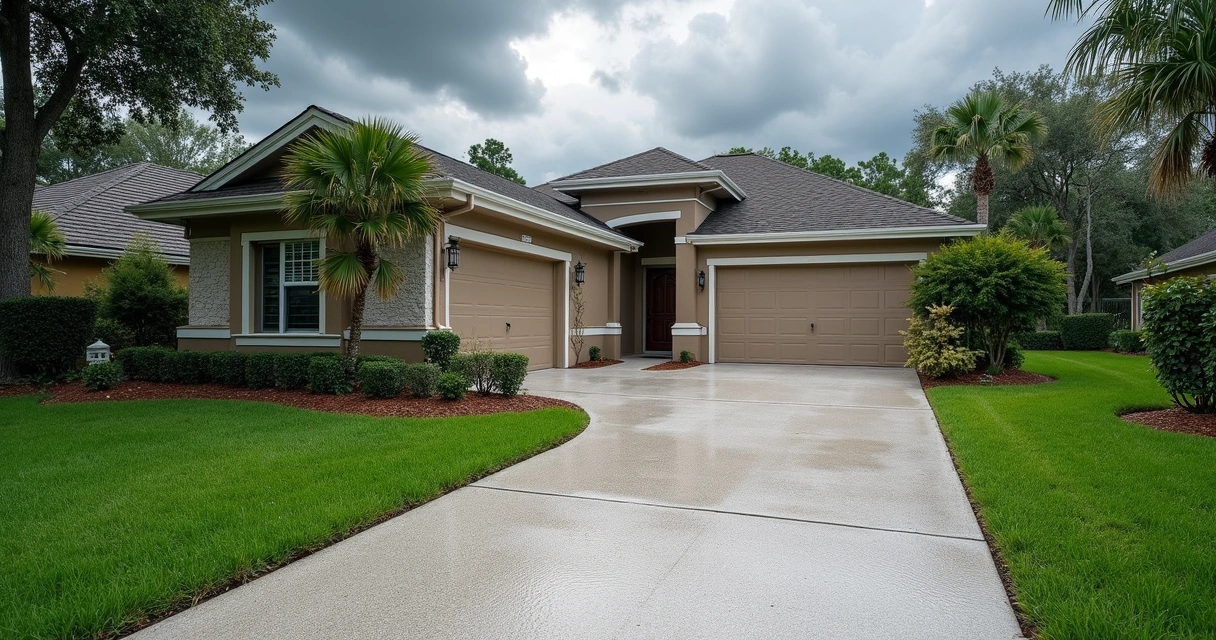
In retrofit work, we use precision grinding, additional concrete, or the removal and rebuilding of sections to restore this all-important slope. Sometimes, older driveways built flat may develop low spots—each repair must put water movement ahead of cosmetic fixes.
Drainage feature #2: Swales, berms, and vegetative buffers
Grading gets water moving, but where does it go next? In Florida, the answer is often into a swale or a vegetative buffer—these are shallow ditches or indented areas designed to channel water and hold it just long enough for it to soak into the ground. Brevard County advises allowing runoff water to remain in swales briefly for infiltration, which improves groundwater recharge and helps prevent downstream surges (Brevard County stormwater practices). Berms are simply raised areas, often of earth or sod, that steer water away from sensitive parts of the yard.
Done right, these features should:
- Collect normal runoff and handle large surges during tropical downpours
- Slow water enough to encourage soaking, not sheeting off into the street
- Help trap sediments and keep fertilizers and chemicals out of the storm drains
- Provide green space that supports native plants and minimizes soil compaction
Swales and buffers do more than drain; they nourish and protect.
We find vegetative buffers can double as attractive landscaped elements and habitat, making the drainage solution part of the curb appeal. For driveway edges, especially on properties with limited green space, you can use reinforced sod, perennial ground covers, or native grasses as a buffer. Parking or paving over these—especially on sandy lots—can reduce infiltration and lead to more runoff, according to Brevard County guidelines.
If you are considering integrating these buffers or want help with driveway-adjacent landscaping, our paver installation and design services blend drainage and style for lasting results in Central Florida conditions.
Drainage feature #3: Trench and channel drains
When grading and landscaping are not enough, trench drains—also called channel drains—are a proven, code-friendly solution for catching driveway runoff right where drivers enter or exit. Pinellas County recommends these types of drains for collecting and redirecting water away from home foundations and low points (Pinellas County flooding prevention). Think of a long, narrow grille set flush into the pavement, running the width of the driveway or across any area where water wants to escape.
Trench and channel drains:
- Intercept water as it runs off the hard surface and carries it safely to stormwater systems, swales, or drywells
- Minimize flooding at the street or sidewalk edge
- Reduce tracking of mud and debris onto the driveway during storms
- Comply with most HOA and city requirements for visible drainage features
- Are available in decorative finishes to blend with pavers, brick, or poured concrete
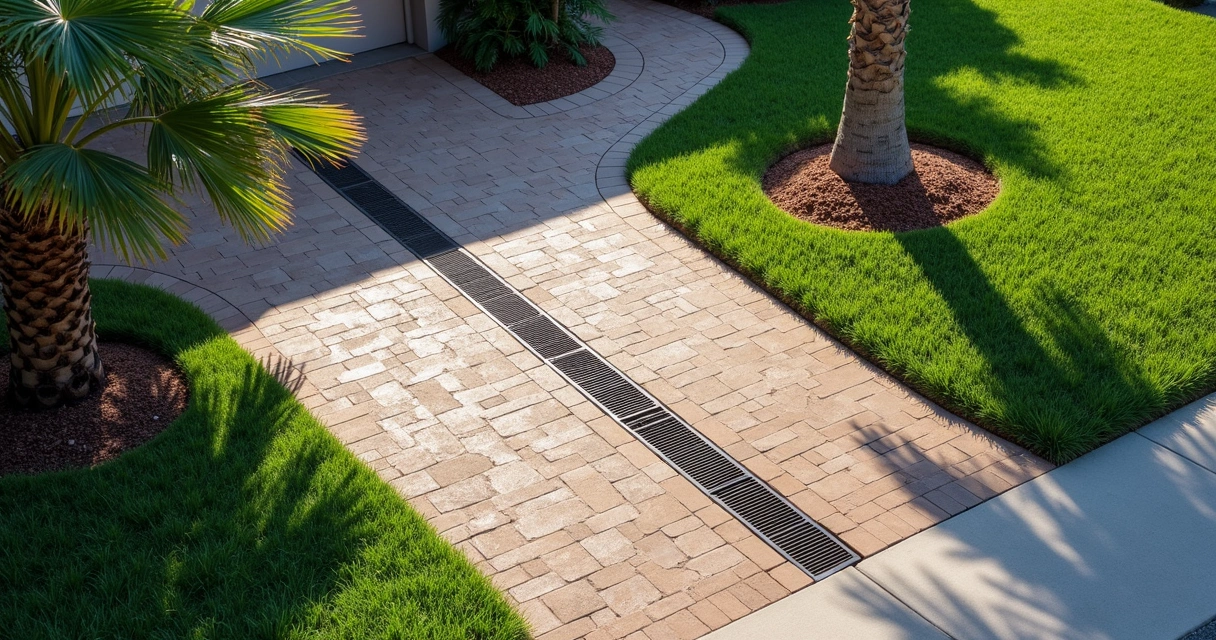
Proper installation is key. At GCM Best Services, we dig a well-compacted base, reinforce the trench, and set the drain at a depth that is level with the adjacent surface to avoid trip hazards or grates popping loose. We match the channel style and color to your hardscape for a finished appearance.
For a deeper understanding of the factors leading up to driveway cracks due to poor drainage, our article on preventing cracks in Florida concrete provides actionable advice for property owners.
Drainage feature #4: Permeable paver and turf systems
The look of concrete or brick is popular, but there is a growing trend in Florida towards permeable paver and turf systems. These surfaces use spaced-out, interlocking bricks or grid structures filled with gravel or synthetic turf, which allow rain to seep through instead of running off. This approach can significantly reduce stormwater surges and offers a more environmentally friendly solution for water-sensitive properties.
Here’s what sets permeable systems apart:
- Water flows through the pavement joints or turf grids into an engineered base of open-graded stone, then filters safely into the subsoil
- Prevents the “sheet flow” that can carry oil, fertilizer, or debris into storm drains
- Reduces the risk of localized flooding and erosion along driveway edges
- Allows for easier repairs or upgrades, as individual units can be replaced without entire removal
However, we’ve observed not every site in Florida is ideal for full-permeable driveways, particularly if the underlying soils compact easily or if there is a high groundwater table. But when conditions permit, the durability and water-handling capacity make permeable paver solutions a smart investment. Pinellas County highlights directing runoff from impervious surfaces like driveways into vegetated or permeable areas to improve overall drainage and reduce the likelihood of yard flooding (Pinellas County flood advice).
For more technical background on paver installations that work with Florida soils and climate, you may wish to review our deep-dive on drainage for paver installations.

Drainage feature #5: Downspout management and redirection
This one is often overlooked—but in our experience, downspouts and roof drains that pour directly onto or beside driveways can cause massive water accumulation, localized flooding, and even undermine slabs or paver beds. Studies and municipal guides such as those from Pinellas County recommend routing downspouts well away from all paved surfaces, and into landscaped or vegetated areas whenever possible (see Pinellas County property protection recommendations).
Good downspout management includes:
- Gutter extensions or underground drainage pipes that redirect water away from driveways and foundations
- Use of catch basins and pop-up emitters for dispersing water onto lawns or gardens, not near the pavement edge
- Careful coordination with driveway and landscape grading to ensure water always finds a safe path off the property
- Ensuring no drain directs water toward a neighboring property or public sidewalk (a requirement in many HOA/municipal codes)
We always inspect and plan for downspout management before pouring a new driveway or installing pavers in Central Florida. This step not only prevents flooding—it can avoid issues with city inspectors or HOA approvals during your next remodeling project.
For driveway projects that require integration with landscape drainage and downspout redirection, consider consulting with our team. We use these strategies as a standard part of every project for reliable, code-friendly outcomes.
Integrating features for Florida code and durability
Most cities and counties in Florida enforce strict codes regarding stormwater management and driveway drainage. For example, Cape Coral’s Surface Water Management Program includes direct inspection of driveway and site grading to verify runoff controls. We always aim to design solutions that are not only practical but also in line with local regulations, so you don’t run into surprise fines or post-install corrections.
Some of the code-friendly practices we follow for driveway drainage in Central Florida include:
- Documenting slopes, materials, and sub-base compaction for HOA and city permit review
- Installing adequate control joints in poured concrete or paver installations to prevent crack formation when water accumulates
- Providing photographic documentation of below-grade drainage features for warranty and inspection
- Coordinating with hardscape layouts for drainage harmony between driveways, walks, and patios
For a wider perspective on blending hardscape features and drainage, our archive of hardscaping projects is full of practical, real-world examples from across Central Florida.
How GCM Best Services delivers driveway drainage in Central Florida
At GCM Best Services, our process starts with a detailed site visit. Our team evaluates not just the physical state of your current driveway, but the surrounding land—trees, rooflines, neighbor lots, swale locations, slopes, sunlight, and all the little details that dictate how water will travel.
Our process includes:
- Free on-site assessment for grading and runoff concerns
- Custom drainage designs for new or existing driveways (concrete, pavers, or turf)
- Permit management, HOA coordination, and photographic jobsite updates
- On-time, OSHA-safe site work with daily cleanups
- Final walkthrough, written warranty, and maintenance advice tailored to Florida’s climate
We build durability from the dirt up—because a Florida driveway is only as strong as its drainage.
If you are thinking of upgrading your driveway or starting new, review our hardscape expertise for more inspiration, or contact us for a quote.
Conclusion: Plan for drainage, invest for the long term
In our experience, drainage is not just another checkbox—it is a key factor in the lifespan, legal compliance, and daily usability of your Florida driveway. The best driveway is one that keeps your home dry, your investment safe, and your curb appeal high, no matter the weather. Each driveway, old or new, deserves an honest look at all five drainage features: grading, swales, trench drains, permeable options, and routed downspouts.
Ready for a professional quote? 📞 (407) 250-1948 • 24–48h • Orlando, Tampa & area.
If you would like to learn how we can tailor the right drainage solution for your property, our team at GCM Best Services is standing by. Experience why Central Florida homeowners choose us for complete, warranty-backed driveway and drainage solutions that last.
Frequently asked questions about driveway drainage in Florida
What is a driveway drainage system?
A driveway drainage system is a combination of features designed to collect, direct, and disperse water away from driveway surfaces and nearby structures. Common components include graded surfaces, trench drains, swales, permeable pavers, and redirection of roof runoff. In Florida, these systems are tailored to handle high rainfall, sandy soils, and code requirements.
How to prevent driveway flooding in Florida?
To prevent driveway flooding in Florida, use a mix of proper grading, swales or vegetative buffers, trench or channel drains at low points, and carefully redirect downspouts away from all paved areas. Maintaining these features and keeping them clear of debris is equally important for lasting performance during heavy rains.
What are the best drainage options?
The best drainage options in Florida usually combine several elements:
- Precision grading to direct water flow
- Swales or vegetative zones to absorb and slow runoff
- Trench or channel drains to catch overflow at entrances/exits
- Permeable pavers or turf grids in appropriate sites
- Managed downspouts flowing into safe landscaped areas
The right mix depends on your lot, soil, layout, and budget. Always consult a local pro, such as GCM Best Services, familiar with regional rules and climate.
How much do driveway drains cost?
Costs for driveway drains in Florida vary depending on size, type, and installation complexity, but most trench/channel drain systems range from a few hundred to a few thousand dollars installed. Simpler grading fixes or swales can be less expensive; full permeable systems or extensive underground piping will require a higher investment. We provide tailored quotes to match your specific project and site needs.
Is driveway drainage worth it in Florida?
Driveway drainage is one of the best investments Florida property owners can make to protect structures, prevent cracks, reduce mold/erosion, and avoid costly repairs. With unpredictable storms, high rainfall, and shifting soils, even driveways that seem dry today can develop problems in the future. Proper drainage features ensure you get the full lifespan and function from your driveway—and peace of mind with every storm.