Primary keyword: driveway drainage slope Variants: driveway slope requirements, proper driveway drainage, driveway grading guidelines
Audience Pain: Homeowners and property managers in Central Florida facing water pooling, cracking, or premature driveway wear due to improper drainage.Benefit: Enjoy reliable, long-lasting driveways with fewer repairs, less water intrusion, and enhanced property value when built to proper drainage standards.
When we plan, build, or renovate a driveway, the slope and drainage are more than just technical details. They define how well your investment stands up against Florida rains and protect your home’s foundation and landscaping. At GCM Best Services, we’ve seen the difference thoughtful drainage design makes to both function and curb appeal across Central Florida. This guide will walk you through choosing the right driveway drainage slope, why it matters, what current codes and guidelines say, and practical tips for ensuring your driveway lasts for the long run.
Contents
- Why driveway slope matters for drainage
- Understanding key grading and slope guidelines
- Current standards and local requirements
- Drainage types and which matters for your driveway
- How to calculate and check your driveway slope
- Common drainage design strategies
- Building for long-term performance in Florida soils
- Maintenance, fixes, and upgrades
- Conclusion
- Frequently asked questions
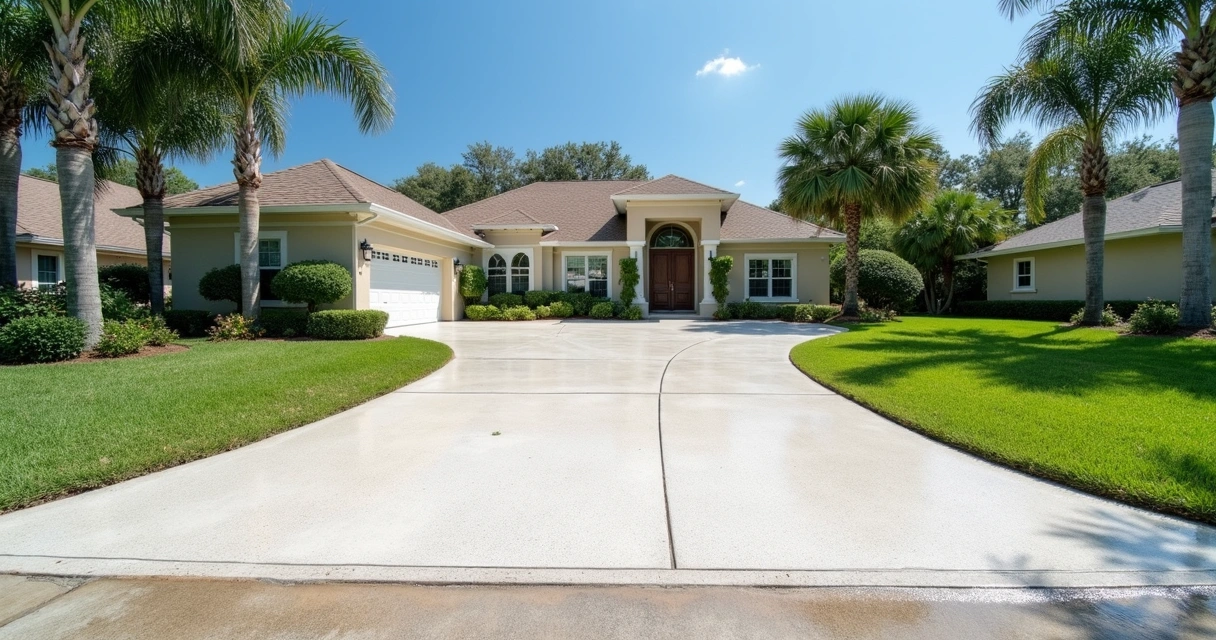
Why driveway slope matters for drainage
Water is always looking for a place to go. On a driveway, if the slope is wrong or the grading is flat, water collects and stays. That moisture can seep into your home’s foundation, lead to slab settlement, or cause deterioration of concrete and pavers. In our experience serving Orlando and Central Florida, over half the cracked and stained driveways we repair have one root cause: improper drainage slope.
A well-sloped driveway means less water, less stress, and fewer repairs.
When driveways don’t shed water, you get puddles, ice (in cooler climates), algae growth, and cracks that never go away. That’s why drainage is never an afterthought in our projects at GCM Best Services. Every successful driveway—concrete, pavers, or other surfaces—starts with the right drainage slope.
Understanding key grading and slope guidelines
So, how much slope is enough, and what do the best standards say? Let’s start with some expert-recommended angles and why they matter.
What grading means for your ground and driveway
Grading means sculpting the ground so water moves away from where you don’t want it (like your home’s foundation) and toward safe areas (like drains or landscaped swales). City of Herriman guidance sets clear rules: a minimum fall of 6 inches in the first 10 feet away from the foundation, or about a 5% slope, to prevent water from pooling near critical areas (https://www.herriman.gov/gradingdrainage).
Most driveways don’t need to be this steep everywhere, but the goal is simple:
- Keep water away from living areas and structural walls
- Move surface water quickly off the drive
- Direct flow toward storm systems, swales, or street gutters
What is a driveway slope?
Driveway slope is the vertical change in height divided by the driveway’s horizontal length, usually expressed as a percentage or ratio. A gentle slope (about 2% to 5%) is enough to move water, but not so steep it’s unsafe or uncomfortable.
Industry standards agree: the University of Massachusetts Amherst recommends a cross slope of about 3% from center to edges for effective runoff.
Slope, grade, and embankment—what’s the difference?
You’ll hear these terms:
- Slope: How steeply a surface rises or falls (vertical/horizontal, as % or ratio)
- Grade: Overall slope of the land, often in %—may refer to lengthwise or crossways
- Embankment slope: The “side” of a driveway, for raised or built-up approaches
All these affect how—and where—water flows.
Current standards and local requirements
Every region, and sometimes every neighborhood or HOA, has rules about driveway slope and grading. We always start our projects by double checking city and county drainage codes. Here’s what we reference most:
- City of Herriman—the minimum fall of 6 inches in 10 feet away from structure foundations
- University of Massachusetts—about 3% typical cross slope for driveways
- New York regulations—maximum slopes of 8–12% in residential driveways, depending on rural or urban zone
- Menlo Park—driveway grade max 20%, earth swales max 6%, cut/fill slopes not steeper than 2:1
- Texas DOT—driveway embankment slopes 1 vertical: 6–8 horizontal, for safety and drainage
In Central Florida, we see code requirements typically ranging from a 2% minimum driveway slope to about 8% maximum, with stricter rules near streets and swales. Homeowner associations sometimes set even tighter limits to keep surfaces accessible and yards uniform.
These numbers might seem small, but they have a big impact. That slight slope keeps hundreds of gallons of water moving in the right direction after every Florida downpour.
Drainage types and which matters for your driveway
Not all driveways need the same drainage. Here’s what we discuss with every customer before breaking ground:
- Cross slope (side-to-side): Typically about 2–3%. Moves water to both sides—works well for driveways with swales or drains running parallel.
- Longitudinal slope (down the length): Often 1–5%. Pushes water to street, alley, or centralized drain.
- Swales and ditches: Grassy or paved channel running alongside, for larger areas or heavy rainfall.
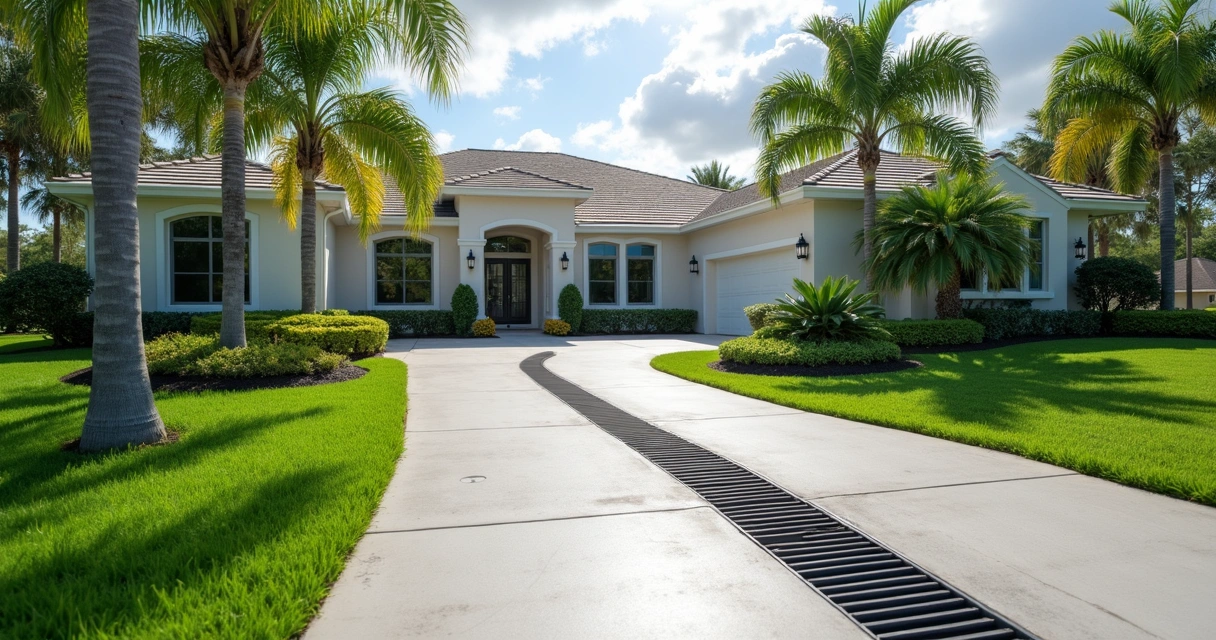
- Channel or trench drains: Built-in linear drainage set below surface—for drives against buildings or with little natural slope.
The best solution depends on lot shape, soil type, local rainfall, and where surface water ends up after leaving the drive.
For nearly flat properties in Orlando, we often use a combination—a gentle cross slope, with a central trench drain leading to the storm system. Combining grading and engineered drains keeps everything moving no matter how heavy the rain.
How to calculate and check your driveway slope
Thinking about your own driveway? Whether building new or checking an old one, measuring the slope isn’t complicated. Here’s our go-to process:
- Gather your tools: Long level (at least 4 feet), tape measure, and a helper.
- Pick your section: The longest continuous area—centerline if possible or across the width.
- Measure horizontal length: Place your level so it is flat; note the length from end to end (e.g., 10 feet).
- Measure vertical drop: Raise the downhill end of the level until it is perfectly horizontal (bubble between lines). Measure from the bottom of the raised end to the driveway surface. This gives the rise (or fall) over that distance.
- Calculate percentage: Divide the vertical drop by the horizontal run, then multiply by 100. Example: 3 inches of drop over 10 feet = (3/120)*100 = 2.5% slope.
A driveway with a slope of 2–5% drains well—but less than 2% is almost flat, and more than 10% can be uncomfortable or unsafe.
If you want precise results, repeat every few feet in different sections, especially in wider driveways or those with twists and turns.
We also recommend checking driveway transitions at the sidewalk, garage, and street entrance—since abrupt grade changes can collect water and trip people or vehicles.
Common drainage design strategies
Designing the slope and overall drainage of a driveway is not one-size-fits-all. At GCM Best Services, we use these proven strategies for new installations and upgrades:
- Start with a well-compacted sub-base (usually 6–8 inches) so the slope stays stable over time. This holds true whether you’re working with concrete, pavers, or turf borders.
- Build to a cross slope of 2–3% unless the lot dictates otherwise. If the land is close to flat, increase the cross slope and use trench drains.
- Add an edge restraint or curb for paver driveways, so water never escapes into landscaping.
- For areas with high water tables, use permeable sub-bases or integrate surface drains to keep run-off moving.
- Make sure transitions (garage to driveway, driveway to street) are smooth and still sloped for drainage.
- Route flows to public storm drains, not just neighboring yards.
You’ll find many of these steps described with more details in our article about effective drainage solutions for brick paver installations in Florida’s climate.
When repairing older driveways, we often retrofit thoughtful trench drains or resurface to adjust slope, as described in our crack prevention and maintenance guide for concrete patios and driveways.
Building for long-term performance in Florida soils
Central Florida’s soils are sandier than most. That’s good for drainage, but it can also mean unstable surfaces if the base isn’t compacted well. We’re strict about driveway subgrades:
- 6–8″ of mechanically compacted base material under any driveway
- Reinforced concrete (3,000–4,000 PSI) with joints and expansion gaps placed as per surface type
- For pavers, well-bonded seams and polymeric sand to prevent water seeping and weed growth
- Drainage gaps or weep holes where paver edges meet the street
If your home regularly floods or your yard collects water, consider adding a French drain, swale, or surface channel—integration with the driveway design, not as an afterthought.
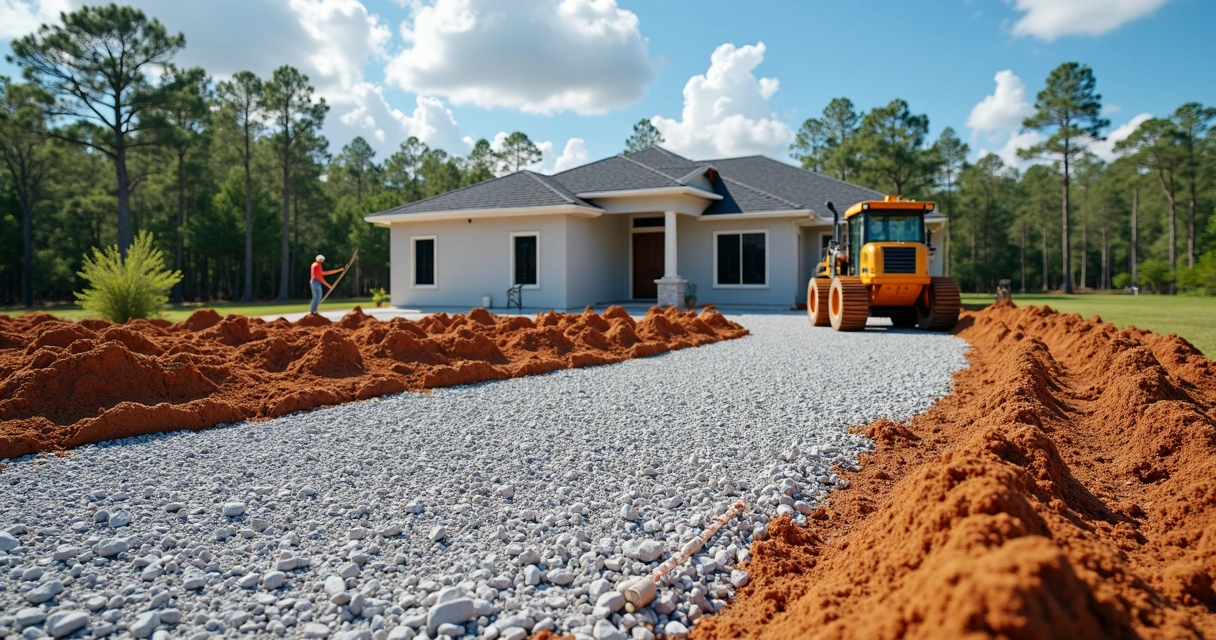
We cover this process and more in our step-by-step concrete driveways and patios installation guide for St. Cloud and Orlando.
Maintenance, fixes, and upgrades
Your driveway’s slope does its job day after day, but it doesn’t hurt to review its condition every year—especially after Florida’s rainy season. We’ve learned a few things you can do to keep drainage working:
- Clear leaves and debris from any surface or trench drains after storms.
- Watch for ponding water that doesn’t drain away—one puddle can mean a bigger grading problem.
- Fix cracks promptly to stop water from seeping below and undermining the sub-base.
- For older properties, consider a resurface or overlay to restore proper slope without a full replacement.
- Check that landscaping hasn’t raised the soil level along the edge, blocking a gentle cross slope.
If you’re considering a new finish or upgrade, see our page about driveway and patio paving for more ideas.
Sometimes, the best fix is a new approach—complete with modern drainage and curb appeal, described step by step on our hardscape solutions overview.
Conclusion: Get drainage right the first time
In the world of driveways, a little slope goes a long way. The right drainage slope isn’t just a number in a rule book—it’s the key to protecting your property, your investment, and your peace of mind.
If you want a driveway that weathers Florida’s worst and looks great doing it, starting with correct drainage planning is non-negotiable. At GCM Best Services, we bring decades of experience navigating building codes, soil quirks, and community standards across Orlando and the Central Florida region. If you’re not sure about your driveway’s current slope, or you want professional help from design to inspection to finish, we’re here and ready to help.
Ready to see what proper drainage design can do for your home? Start with an inspection or consultation—we’ll bring our know-how, our measurement tools, and warranty-backed solutions built for Central Florida’s unique needs.
Set your driveway up for success by trusting the slope—and the expertise—of the pros.
Contact us at GCM Best Services to schedule your free, no-obligation assessment. We’ll show you what drainage should look like—then build it.
Frequently asked questions
What is a driveway drainage slope?
A driveway drainage slope is the angle or incline built into a driveway’s surface so that rainwater naturally flows off, instead of pooling. By having the surface higher at one side or end (or both), water runs off quickly to a drain, swale, or gutter. This is measured as a percentage (e.g., 2% means 2 inches of fall per 100 inches of run). The right slope keeps driveways dry and helps prevent cracking, erosion, and water damage.
How much slope should a driveway have?
According to University of Massachusetts Amherst’s guidelines, a typical cross slope of about 3% works well for most driveways. In practice, most driveways perform best with a slope between 2% and 5%, or about 1/4 inch drop per foot of driveway width or length. Too little slope (less than 2%) isn’t effective for draining water, especially after a summer storm.
How to measure driveway slope properly?
Place a long level on the driveway and raise one end until it is perfectly level. Measure the vertical drop from the driveway surface to the raised end, then measure the length of the level between ends. Divide the drop by the length, then multiply by 100 for the slope percentage. For example, a 3-inch drop over 10 feet equals a 2.5% slope (3″ ÷ 120″ × 100).
What happens if slope is incorrect?
If the slope is too flat, water will pool, soaking into the concrete or pavers, which leads to faster wear, stains, algae growth, and cracks. If too steep, driveways can become slippery, unsafe for cars and pedestrians, or prone to erosion. In both cases, incorrect slope shortens your driveway’s lifespan and creates property hazards. Fixing slope issues early is much easier and less costly than replacing the whole surface.
Who can install driveway drainage systems?
Licensed and insured contractors with experience in driveway installation—like GCM Best Services—are best suited for drainage system work. It’s important to choose professionals who understand soil types, local building codes, and the best approaches for lasting drainage. In Central Florida, we manage everything from permits to grading, ensuring built-in drainage that’s backed by warranty and proven results.
Ready for a professional quote? 📞 (407) 250-1948 • 24–48h • Orlando, Tampa & area.