
By Gabriel Cavalcante, owner of GCM Best Services Corp · November 28, 2026
In ShortRepair a concrete driveway when the damage is small and contained: hairline cracks, one sunken panel that is still in one piece, or light wear on sound concrete. Replace it when the problems run across the slab: wide or growing cracks through several panels, panels that keep sinking, broken edges, water that pools or runs toward the garage, or patches on patches. In Central Florida the cause usually sits under the concrete: sandy soil that settles or washes out, heavy wet-season rain, a high water table or tree roots. A repair works on the slab you have; a replacement rebuilds the base, the slope and the joints.
First, look at what is under the crack
Concrete shrinks as it cures and dries. The National Ready Mixed Concrete Association (NRMCA) notes that completely crack-free concrete is not possible and that most early random cracks rarely affect the slab's structure or service life. What changes the answer is movement: a crack that keeps opening, a panel that drops, an edge that rises. Movement means something under the slab changed, and a surface fix does not reach it. Source: NRMCA CIP 4, Cracking Concrete Surfaces (PDF).
Signs and what they usually mean
Walk the driveway the day after a heavy rain, when low spots still hold water and problems are easier to see.
Hairline cracks
Thin cracks with both sides level are usually shrinkage, which NRMCA describes as unsightly but generally harmless to the integrity of the concrete. Sealing them keeps water out of the base, and leaving them alone is often fine too. Source: NRMCA CIP 6, Joints in Concrete Slabs on Grade (PDF).
Wide or growing cracks
A crack that keeps opening, or one that wanders across a panel instead of following the joints, points to movement under the slab. One wide crack in one panel can sometimes be repaired. Wide cracks in many panels usually mean the base has given way in several places.
Cracks with a height difference
When one side of a crack sits higher than the other, the slab has settled or been pushed up, and the raised edge is a trip hazard. A panel still in one piece can sometimes be lifted back into line; a broken or still-moving panel is unlikely to stay there.
Sunken or settled slabs
A panel that has dropped, often next to the garage, the street or a downspout, usually has a soft or washed-out base under it. One sunken panel on otherwise solid ground is a candidate for repair. Several sunken panels, or one that sinks again after it was lifted, point to the base.
Water pooling or running toward the garage
Puddles that stay after a storm, or water running into the garage, mean the slope is wrong, from the day of the pour or because panels settled. Crack sealing and lifting cannot regrade a whole driveway, so the fix is usually new concrete. Our guide to driveway drainage in Florida covers slope and drains.
Surface scaling or spalling
Scaling is the top layer flaking or peeling off. In cold climates, freeze-thaw causes most of it. Hard freezes are rare in Central Florida, and NRMCA notes that scaling without freeze-thaw often comes from finishing: steel-troweling too early, overworking the surface or finishing with water on top. Minor scaling is mostly cosmetic. Spalling goes deeper, with pieces breaking out at joints and edges; rust stains or bare steel mean the reinforcement is rusting, and a patch will not stop it. Source: NRMCA CIP 2, Scaling Concrete Surfaces (PDF).
Tree-root heave
Roots under a slab push it up, so the driveway rises, cracks and tilts near the tree. Patching does nothing about a root that keeps growing, and cutting large roots can harm the tree, so the fix starts with an arborist's advice.
Edges breaking off
Edges crack and break when nothing solid is under them, because rain or a sprinkler washed the sand out or tires keep running off the side. A small broken corner can be patched. A long stretch of broken edge usually means the support is gone along that whole side.
An old driveway with many patches
Every repair adds a seam, and NRMCA notes that repair material will not match the color and characteristics of the original concrete. Patches on patches, with new cracks beside old repairs, mean the slab and the base under it are worn out. At that point, another repair mostly buys time.
Why Central Florida driveways fail from below
Driveway trouble here comes from water and soil more than from cold.
- Sandy soil. Much of Central Florida sits on sand. Sand that was not compacted well settles, and the slab cracks where it loses support.
- Heavy rain. The National Weather Service office in Melbourne puts the median start of Orlando's wet season in late May and its end in mid-October. Source: NWS Melbourne, Orlando wet and dry season dates.
- High water table. In low, flat areas the water table rises near the surface in the rainy season, so the ground under a slab can stay wet long after the rain.
- Washout. A downspout, a gutter or a sprinkler aimed at the edge can wash sand from under the slab and leave a hollow.
- Tree roots. Roots from large trees near the driveway lift and crack the slab as they grow.
Repair options, and where each one stops
In general terms, each of these repairs works on the slab you already have, so each depends on that slab and its base being mostly sound.
Crack sealing. A flexible sealant keeps water from running through the crack into the base. It suits thin, stable cracks and does not stop movement.
Slab lifting or leveling. Grout or foam is pumped under a sunken panel to raise it and fill the void. It suits a panel still in one piece, but it does not fix a broken panel, the overall slope or the water that washed the base out, so the panel can drop again.
Resurfacing or an overlay. A thin bonded layer covers scaling and wear. NRMCA notes that a repaired surface is only as strong as the concrete it is bonded to, so an overlay needs sound concrete underneath.
Replacing one section. Cutting out one panel and pouring it again can work when the damage is local. The new panel will look newer than its neighbors.
GCM replaces concrete driveways, from demolition to the new pour, and installs paver driveways. If a repair is enough, we'll tell you; if the driveway needs replacing, we give you a free written estimate.
When replacement makes more sense
Replacement is the better call when the problem is the base or the whole slab: cracking across most panels, several panels sunken or tilted, a panel that sank again after lifting, roots under much of the driveway, patches on patches, or a slope that sends water toward the house. A repair would sit on the same failing base or the same wrong slope. A replacement is also the time to change the layout, such as a wider driveway or a walkway to the door. Our concrete driveway replacement page lists what that work includes.
What a concrete driveway replacement involves
A replacement rebuilds the driveway from the ground up:
- Permits and layout. Permit and HOA rules for your address are checked, and the layout and slope are set.
- Demolition and haul-off. The old concrete is broken up and hauled away.
- Base check and compaction. NRMCA's guidance is to remove topsoil and soft spots and to compact the soil or granular fill under the slab well. Low areas are filled and compacted.
- Forms and slope. Forms set the edges and the height, with the surface sloped away from the house and the garage.
- Reinforcement as specified. Rebar or wire mesh goes in where the design calls for it. NRMCA notes that reinforcement cannot prevent cracking, but placed correctly it can reduce crack width.
- Pour, finish and joints. The concrete is placed and finished, with a broom finish for traction. NRMCA recommends control joints no farther apart than 24 to 36 times the slab thickness, with 15 feet as a recommended maximum, cut at least a quarter of the slab's depth, with panels close to square. Isolation joints separate the driveway from the garage slab and the sidewalk.
- Curing. NRMCA describes curing as starting right after finishing and lasting typically 3 to 7 days, using a curing compound, wet coverings or plastic sheets. In Florida heat, the surface must not dry out too fast. Ask before the pour when cars can drive on it, since that depends on the mix and the weather.
Sources: NRMCA CIP 4, NRMCA CIP 6 and NRMCA CIP 11, Curing In-Place Concrete (PDFs).
Replacing it with pavers instead
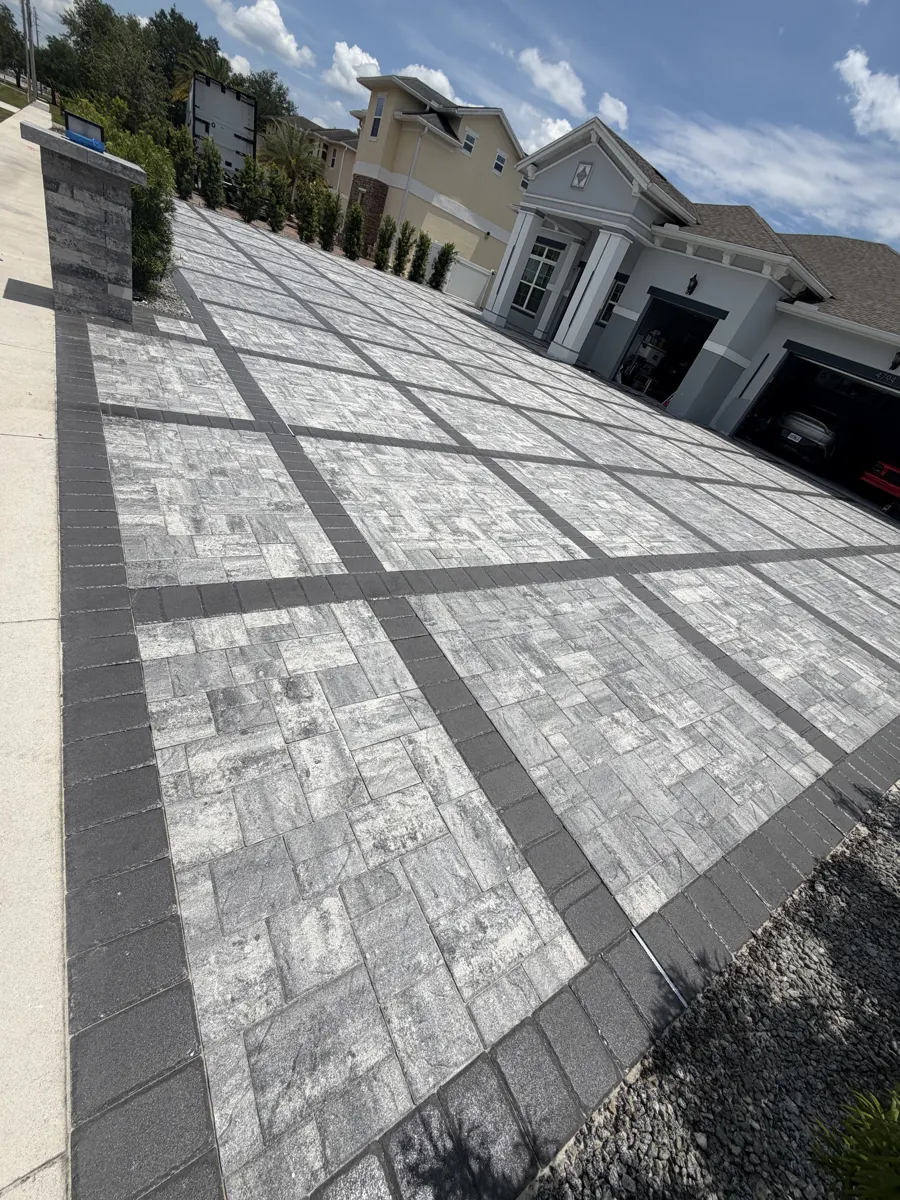
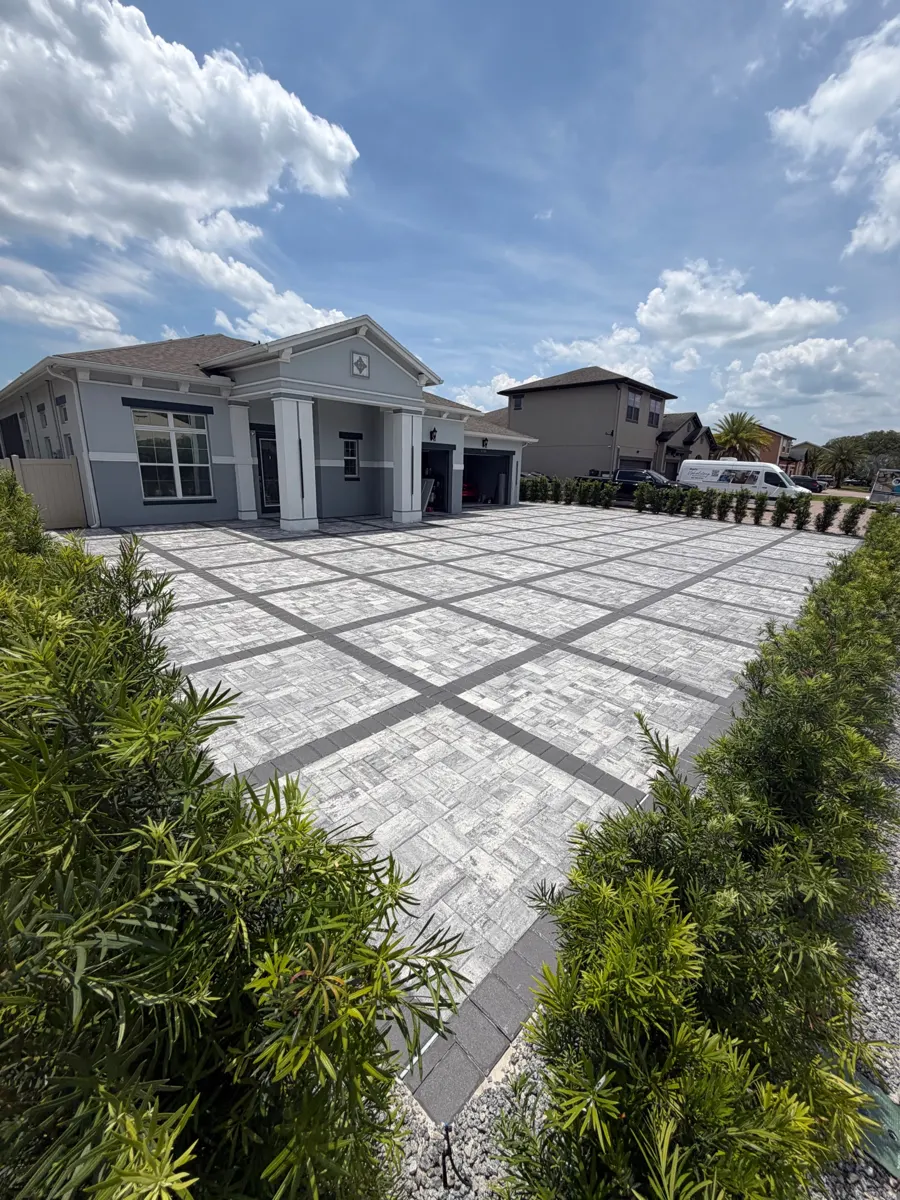
Since the old slab comes out anyway, it is a good moment to compare materials. A paver driveway sits on a compacted base with sand-filled joints, so if one spot settles or a root needs attention, those pavers can be lifted, the base fixed and the same pavers reset. On a concrete slab, the same problem means cutting and pouring new concrete.
We install both, and one free written estimate can cover both side by side. See our paver driveways, or compare them in paver vs poured concrete driveways, pavers vs stamped concrete and the best driveway materials for Florida.
Permits and HOA approval
Permit rules depend on where you live. A driveway replacement may need a permit, and work on the apron or in the public right-of-way along the street may need its own approval. Rules differ between the City of Orlando, unincorporated Orange County, Osceola County and nearby cities, so check which ones apply to your address before work starts. HOA communities often require architectural approval, especially for a new material or color; we prepare the scope and material details the HOA asks for.
Signs checklist
Checks in the first group usually point to a repair; checks in the second, to a replacement.
Usually a repair
- Thin cracks with both sides level
- One sunken panel that is still in one piece
- Light scaling on otherwise solid concrete
- A small broken corner
Usually a replacement
- Wide or growing cracks across several panels
- Panels at different heights in more than one place
- A panel that sank again after it was lifted
- Water pooling or running toward the garage or the house
- Roots lifting a large part of the slab
- Edges broken along a whole side
- Patches on patches
Not sure which group your driveway falls in? Send us a few photos of the whole driveway and close-ups of the worst spots. If a repair is enough, we'll tell you; if the driveway needs replacing, we give you a free written estimate. Request a free written estimate.
Driveways across Central Florida
We replace concrete driveways and install paver driveways across Orlando and Central Florida:
Frequently Asked
Should I repair or replace my cracked concrete driveway?
Repair it when the damage is small and contained: thin cracks, one sunken panel that is still in one piece, or light surface wear on otherwise sound concrete. Replace it when cracks, settling or drainage problems run across several panels, when repairs keep failing, or when the slope sends water toward the house or the garage. Most of these problems start in the base under the slab, and only a replacement rebuilds the base.
Are hairline cracks in a concrete driveway normal?
Usually, yes. Concrete shrinks as it cures and dries, and the National Ready Mixed Concrete Association notes that completely crack-free concrete is not possible. Thin cracks with both sides level rarely affect the structure. Watch for cracks that widen, multiply or develop a height difference, because those point to movement under the slab.
Can a sunken driveway slab be raised instead of replaced?
Often, if the panel is still in one piece. Slab lifting pumps grout or foam under the panel to raise it and fill the void. It does not fix a broken panel or the water that washed the base out, so if the cause stays, the panel can sink again. Several sunken panels usually point to a base problem, and that points to a replacement.
Do I need a permit to replace a concrete driveway in Central Florida?
It depends on the city or county. A driveway replacement may need a permit, and work on the apron or in the public right-of-way may need its own approval. The rules differ between Orlando, Orange County, Osceola County and the cities around them, so they are checked for each address. HOA communities often require architectural approval as well.
What does GCM do if my driveway only needs a repair?
We tell you. GCM replaces concrete driveways, from demolition to the new pour, and installs paver driveways. Send a few photos of your driveway: if a repair is enough, we'll tell you; if the driveway needs replacing, we give you a free written estimate.