Concrete projects in Central Florida face a unique set of challenges: expansive soils, high humidity, and sudden rains. Through our experience at GCM Best Services, serving Orlando and the region, we’ve learned that proper joint placement and spacing are the backbone of every successful slab, driveway, or sidewalk. In this article, we’ll explain why joints matter, how to determine the best layout and spacing, and what you can expect for long service life—using data-backed standards and local know-how.
The right joint plan stands between you and those unsightly cracks.
Choosing a contractor who understands concrete joints is the first step to a lasting investment in your property.
What are concrete joints and what do they prevent?
We often describe concrete as “liquid rock,” but it’s far from unbreakable. As it dries, temperature and moisture changes force the concrete to shrink, expand, and contract. Without planned relief points—joints—the tension inside the slab will seek the path of least resistance and crack at random.
Concrete joints are deliberate separations created in slabs, pavements, and flatwork to accommodate shrinkage, movement, and stress, ensuring cracks form in predictable, controlled lines rather than randomly across the surface.
There are three main issues joints are designed to combat:
- Random cracking from shrinkage and drying
- Expansion and contraction due to temperature swings
- Surface distortion, including ponding and settling caused by inadequate relief
With the right layout and type of joint, we can direct any inevitable cracking along straight, weak planes that don’t harm appearance or function.
Types of concrete joints and how each one works
Depending on the function, scale, and exposure of your concrete project in Central Florida, we select from a few key joint types. Each brings a specific purpose and installation detail.
Contraction joints: Guiding cracks on purpose
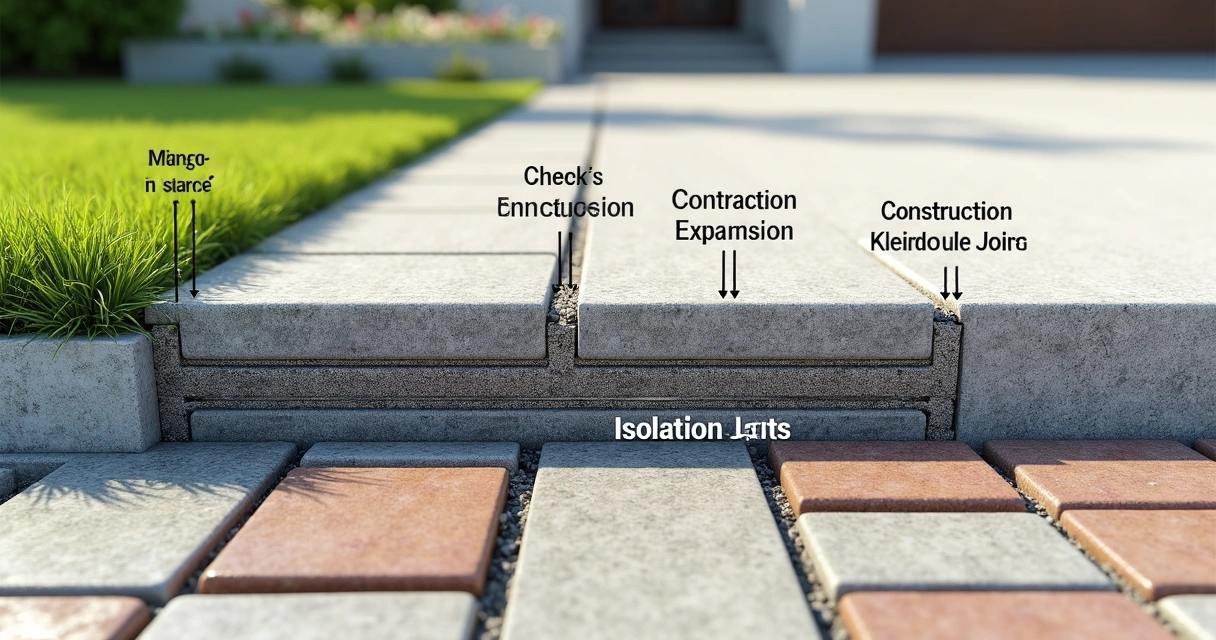
Contraction joints, sometimes called control joints, are intentional grooves placed in fresh concrete, typically at the quarter-depth of the slab, to control where cracks will occur. We saw or tool these joints soon after the pour to create a vertical plane of weakness.
By placing contraction joints at proper intervals, we encourage controlled, straight cracks that don’t affect performance or integrity.
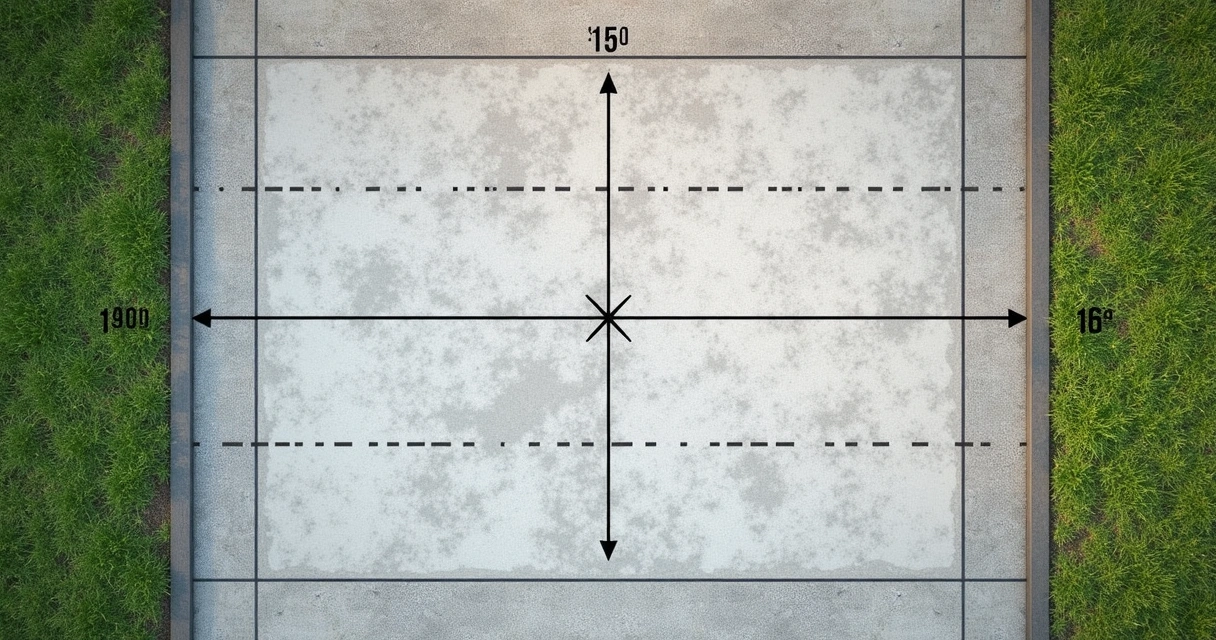
According to Texas Department of Transportation recommendations, a standard 15-foot spacing is considered effective for preventing uncontrolled cracks in unreinforced concrete pavements.
Expansion joints: Absorbing movement and separating structures
Expansion joints are full-depth separations filled with a compressible material, like felt or foam, designed to isolate slabs from each other or from adjoining materials (e.g., buildings, steps, columns). When temperature rises and concrete grows, these joints let it move freely without causing buckling or collision damage.
We use expansion joints especially where:
- Driveways meet garage slabs or sidewalks
- Pool decks connect with house walls
- Large outdoor slabs end at structures or rigid barriers
Construction joints: Where work pauses and resumes
Whenever concrete placement is interrupted (overnight or across multiple days), we create a construction joint to “cold join” two separate pours. These are commonly placed at slab edges or in long runs and are carefully keyed or doweled to transfer loads while still allowing some movement.
Isolation joints: A special case of expansion joints
Isolation joints are often confused with expansion joints, but their main intent is to fully separate a slab from adjacent surfaces—allowing vertical and horizontal movement, especially crucial in Central Florida where soils are prone to movement.
 Why joint placement and spacing are critical for Florida concrete
We see many driveways, patios, and sidewalks in Orlando fail early—not because of bad concrete or subbase, but due to poor joint planning. Correct joint placement and spacing is the difference between a surface that lasts decades, and one that cracks within the first season.
Some real-world benefits of getting it right:
- Surfaces resist ugly, hazardous cracks that can cause water infiltration and trip hazards
- Slabs maintain flatness (avoiding ponding) since joints relieve curling stresses
- Simple maintenance—when cracks do appear, they’re uniform, narrow, and typically not structurally significant
For local soils and rainfall patterns, we factor in drainage slopes so joints never collect standing water or debris. For an in-depth discussion of drainage design and its impact, take a look at our guide to preventing cracks in concrete patios and driveways.
Standards for joint spacing: What science says
Many homeowners are surprised to learn that joint spacing isn’t an art—there’s strong research and clear standards behind every recommendation we make. The ACI (American Concrete Institute) offers guidelines, but let’s focus on the data.
A Texas Department of Transportation guideline calls for a 15-foot maximum spacing for contraction joints on unreinforced concrete pavements—a rule echoed in many DOTs and national recommendations.
Even more convincing, Long-Term Pavement Performance data shows that this 15-foot interval provides better crack control and less surface faulting compared with wider spacings (such as 20 or 25 feet).
Supporting this, Purdue University’s research estimates that reducing joint spacing from 18 feet to 15 feet leads to measurable cost savings and longer service life.
Closer joints mean fewer—and narrower—cracks in the long run.
How we determine joint location and layout for Orlando installations
Every job we do at GCM Best Services starts with a site visit and slab design matched to the specific location. There’s no one-size-fits-all. The joint plan depends on:
- Slab size and shape (irregular layouts require special attention at corners and reentrant angles)
- Purpose—driveways need more reinforcement than walkways; patios might have decorative zones
- Concrete thickness and strength (thicker or reinforced slabs may allow slightly larger spacing)
- Local loads—vehicle weights, foot traffic, heavy planters, outdoor kitchens
We review these conditions and tailor the joint pattern so that no panel is overly large or odd-shaped, and all edges are well-supported.
Planning joints isn’t just about straight lines. When curves, steps, and pool decks are involved, we often mix sawed, tooled, and poured-in-place joints for seamless transitions and aesthetics you’ll love.
Basic rules of thumb for joint layout
We follow a few key guidelines, rooted in science and field experience:
- Keep contraction joints at 24 to 36 times the slab thickness (so a 4″ driveway slab = max 8–12 feet between joints)
- Never allow irregular-shaped panels—always target squares or rectangles, with a length:width ratio under 1.5:1
- Place joints at stress concentration points: reentrant corners, around drains, at the ends of steps or planters
- Extend joints through curbs or across the full width of the slab when possible for maximum relief
 Joint construction methods we use at GCM Best Services
The timing and technique matter as much as the layout itself. If contraction joints aren’t installed at the right moment, random cracking will beat us to the punch. Here’s how we do it for projects around Orlando:
- Sawed joints: For larger flatwork, we saw joints within 4 to 12 hours of finishing, before significant shrinkage stress accumulates. Depth is at least 1/4 of the slab thickness. We use wet- or dry-cut saws with dust control systems for clean, straight lines.
- Tooled joints: For decorative or small-scale projects, joints are pressed in while the concrete is still plastic. Edges are rounded for a crisp look, often used on sidewalks and broom-finished patios.
- Formed joints: For expansion and isolation joints, we install boards or compressible strips before pouring, then remove or leave in place based on design.
- Sealant finish: When needed, especially in driveways and walkways exposed to frequent rainfall, we use flexible sealants in expansion and isolation joints for water intrusion control.
The sequence and quality of our joint work are backed by written warranties and in-progress photos on every project. If you want to see our process in more detail, our concrete project portfolio showcases real results from Orlando and Central Florida.
Joint spacing case studies: From driveway to patio
We’ve applied joint planning on hundreds of projects in the Orlando area. A few stories stick with us, because they show just how much difference good jointing makes:
Driveway replacement: Preventing patterns of failure
A homeowner contacted us to replace their cracked, uneven driveway. The original slab featured 20-foot panels with no contraction joints—just one long uninterrupted run.
When we poured the replacement, we used 8-foot by 8-foot panels for each car lane, with 3/8-inch deep sawed joints at every transition and around the slab perimeter. After several years, the joints are performing just as designed: straight, uniform, with no random cracks disrupting appearance or function.
Broom-finished patio: Elegance with hidden science
On a recent patio install, the client worried about visible lines marring the finish. Our solution blended sawed and tooled joints, placed symmetrically under the outdoor furniture footprint and near the edge transitions to lawn and pavers.
Not one random crack has appeared in three years—just clean, intentional lines that blend right in.
Adjusting joint plans for stamped, exposed, and decorative concrete
Decorative concrete is as demanding beneath the surface as it is above. When working with stamped, exposed aggregate, or colored concrete, we take extra care to “hide” contraction joints within pattern lines or align them with stamped texture seams for a seamless aesthetic.
For these projects, we plan:
- Tool joints in borders to frame the slab naturally
- Careful saw cuts after stamping, using stain and joint sealers to minimize appearance
- Extra attention to joint radius and smoothness, so nothing distracts from the color or pattern
Our approach delivers surfaces as durable as they are beautiful. For more about local stamped and decorative installations, the St. Cloud concrete guide covers designs and joint ideas for patios and more.
 Aftercare and inspection: Keeping joints performing for years
Even the best-planned joints need maintenance, especially as Florida’s hot-cool cycles and heavy rains wear on concrete year after year. We always provide a warranty and maintenance guide, but here’s what we stress in conversation:
- Keep joint gaps free of weeds and dirt for clean water runoff
- Inspect expansion joints for missing or failing filler, resealing as needed
- Avoid heavy point loads (e.g., dumpsters or storage) on unsupported slab panels
- Re-seal decorative joints every few years for maximum lifespan
For homeowners who want to understand when to call a professional, our concrete repair guide breaks down common issues and fixes, including signs a joint isn’t performing as planned.
When should you hire GCM Best Services for joint planning?
The answer is simple: before you pour, cut, or even order concrete. Joint placement and spacing cannot be fixed after the slab is set. We review every surface, drainage slope, and support detail, so your investment in a driveway, patio, or walkway stands up over time.
Often, our clients in Central Florida ask about costs and options for upgrades (like rebar, mesh, or advanced waterproofing). These can complement a joint plan, but they’ll never replace it. If you want to get the job started, schedule a free on-site assessment—we’ll measure, design, and explain our recommendations step by step.
Your concrete is only as good as its joint plan. The best time to do it right is before the first wheelbarrow rolls in.
For more on planning your project, our article on choosing the right concrete company in Orlando offers further tips and insights.
Conclusion: Joint planning—where value outlasts first impressions
At GCM Best Services, we’ve seen the difference that an informed approach to concrete joints can make in Central Florida. Beautiful finishes and strong schedules mean little if the slab is fighting internal stresses from the start. That’s why our process for every project—driveway, patio, sidewalk, or slab—puts joint spacing and placement at the heart of the plan.
Care for your concrete by caring about joints, and you’ll get a driveway that looks sharp a decade after the pour, or a patio that hosts gatherings without cracks becoming conversation starters.
If you’re ready to see real results, backed by warranty and a clear plan, we encourage you to book a no-obligation assessment today. You can expect expertise, clarity, and local commitment from the GCM Best Services team.
Ready for a professional quote? 📞 (407) 250-1948 • 24–48h • Orlando, Tampa & area.
Frequently asked questions about concrete joints
What are concrete joints used for?
Concrete joints are used to direct cracking, movement, and expansion within a concrete slab, so stresses are relieved in straight, planned lines rather than randomly across the surface. By adding joints at key locations and intervals, we make sure the surface stays attractive and safe, while avoiding early failure.
How far apart should joints be?
The recommended spacing depends on the slab thickness and strength, but typical residential flatwork (e.g., driveways and sidewalks) uses joints every 8 to 15 feet. For example, the Texas Department of Transportation recommends a 15-foot interval for contraction joints in unreinforced slabs, and LTPP research supports this as the spacing with best long-term performance.
How to choose joint placement locations?
We select joint locations based on slab size, shape, thickness, and the location of load points or stress concentrations. Joints should break the slab into square or nearly square panels, avoid L-shaped or wedge-shaped sections, and cross at high-stress locations (such as reentrant corners, sides of drains, and major transitions). The goal is always to control likely crack points and let movement happen where it won’t harm appearance or function.
Are concrete joints really necessary?
Yes. Without joints, concrete will still crack, but along random lines that damage both strength and looks. Properly placed joints let us predict and control these cracks, extending surface life, improving safety, and simplifying maintenance. In areas with cycles of heat and rain like Central Florida, joints are even more important due to climate-driven movement.
What types of concrete joints exist?
There are four main types:
- Contraction (control) joints—placed while concrete is fresh or just set, to guide shrinkage cracking.
- Expansion joints—full-depth separations with flexible material, allowing for thermal growth.
- Construction joints—used where placing concrete is paused, and needing reinforcement ties/dowels.
- Isolation joints—a special expansion joint, fully separating slabs from adjacent structures to absorb movement.
Each type has a distinct purpose in keeping your slab performing over time.