Living in Central Florida, hurricanes aren’t a distant threat—they’re woven into the local calendar. Sometimes, the wind feels playful, bending branches and tossing leaves. At other times, it barrels in, armed with restless gusts that test every structure’s limits. For many of us, that means wondering—not just if our homes can withstand the storm, but whether our screen enclosures are tough enough to protect everything behind them.
At GCM Best Services, we know these concerns are personal. We’ve walked properties after storms, run our hands along warped aluminum, and listened to customers who’d trusted a space to house family, friends, pets, or just a favorite chair by the pool. Screen enclosures create comfort and extend living space but, when hurricanes approach, they face some of the roughest tests of any part of the property.
We believe that preparation isn’t about fear. It’s about confidence. And, with new advances in materials, codes, and design, we can help make your screen enclosure stronger, safer, and worry-free—even when the wind howls, and rain soaks every edge. Here are the seven features we recommend for anyone in Florida looking to upgrade their screen enclosure for hurricane season.
Safety in a storm starts long before the skies darken.
Why screen enclosures are vulnerable to hurricanes
Hurricanes challenge every exterior surface, but screen enclosures stand at a unique crossroads. Their wide spans of mesh, lightweight aluminum frames, and long roof lines mean they can catch extreme wind loads and, if not built right, may fail dramatically.
- Panels can tear free, sending debris into pool decks and yards.
- Aluminum frames may bend or collapse if bracing is lacking.
- Connection points—bolts, screws, anchors—are often the first to rust or fail, giving way under storm stress.
Florida’s building codes have shifted after hurricanes like Andrew, Irma, and Michael. According to Hurricane Science and Society, tougher requirements for impact resistance and better anchoring have become mandatory in higher wind zones. Still, many older enclosures—or even some newer but basic builds—don’t offer true hurricane-ready protection.
We often see clients with beautiful lanais or pool cages, but the structures rely on out-of-date materials or overlook key upgrades. That’s where the right features make all the difference.
The 7 must-have features for hurricane-ready screen enclosures
Upgrading for hurricane season isn’t just about checking a box on the code. It’s about merging safety, longevity, and the peace of mind to enjoy your outdoor space, no matter the forecast. Here’s what, in our experience, every truly resilient enclosure must have:
- High-wind-rated aluminum framing
- Diagonal cable bracing and reinforced connections
- Corrosion-resistant fasteners and anchors
- Impact-resistant screen mesh and panels
- Hurricane shutters or removable windbreak panels
- Upgraded doors, latches, and threshold systems
- Improved engineering for foundations and tie-downs
We’ll break down each feature—the why, the how, and the subtle details that matter.
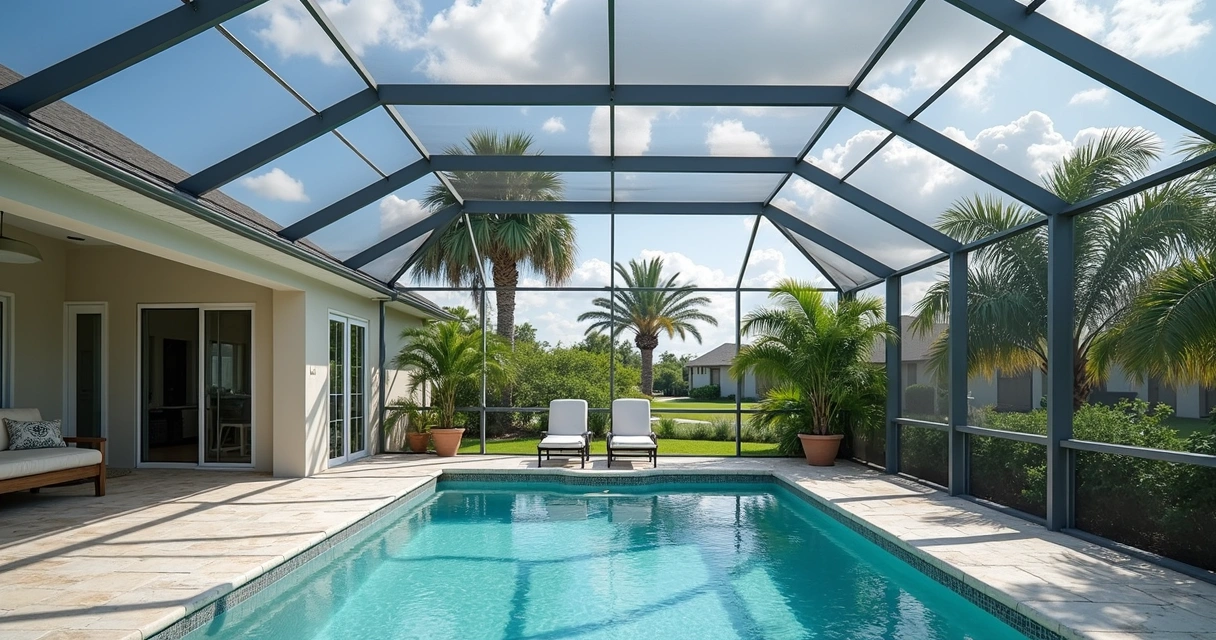
High-wind-rated aluminum framing
We start with the backbone. Modern building codes demand that aluminum framing must meet or exceed the wind speeds forecast for each zone. For Central Florida, that means designing for gusts up to 140–150 mph. But not all aluminum is the same. The gauge, alloy, and sectional shapes all change how your enclosure responds to pressure.
- Thicker posts and beams offer more resistance to flexing and collapse.
- Engineered joints—such as internal stiffeners at corners or T-joints—spread out wind energy.
- Corrosion coatings (powder coat, anodized finishes) help prevent weakening over time.
Older enclosures often lack these features. They may sport spindly posts with barely enough wall thickness or rely on thin muntin bars between screen sections. When we upgrade, we focus first on the heavy hitters: corner posts, roof beams, and door frames. Every connection is only as strong as the metal behind it.
A sturdy frame is the difference between a strong shield and a crumpled shell.
Diagonal cable bracing and reinforced connections
According to guidance from the Florida Division of Emergency Management, one of the common failures in older or lightly-built enclosures is a “racking” collapse, where frames twist sideways under wind. The answer is bracing.
We install diagonal stainless steel cables between vertical columns and roof sections. These cables function much like cross-braces in a hurricane-proof tower. When wind pushes on the enclosure—or tries to suck a panel away—these braces share the load and prevent distortion.
It’s not just about stringing up a wire. Proper bracing means:
- Anchoring the cable deep into the ground or concrete slab
- Using turnbuckles to keep perfect tension, without sagging or slack
- Distributing forces so that no post gets overloaded
We also prioritize stronger corner brackets and oversized lag screws at critical joints. In storms, failures start at the weak points. Once one section gives, a chain reaction follows. Cable bracing can halve that risk.
Corrosion-resistant fasteners and anchors
It surprises many people, but the right screws and bolts are sometimes more important than the frame itself. In damp, salty air—or after repeated rain—the average zinc screw will corrode within a few years. When we inspect older enclosures, we find missing screws, softened anchor bolts, or rust blooms at the base.
Modern hurricane upgrades specify:
- Stainless steel or coated fasteners for every structural joint
- Heavy-duty wedge anchors in concrete pads
- Plastic or rubber isolator washers to separate metals (reducing “galvanic” corrosion)
- Sealant at bolt heads to stop water intrusion
It’s the small things—literally, the screws and bolts—that hold up when wind shakes the frame. Florida’s codes and mitigation studies highlight the need to prioritize these connections above almost every other point of upgrade.
A frame is only as strong as the fasteners that hold it together.
Impact-resistant screen mesh and panels
The screen itself—it matters more than people think. Every year, loose tiles, small branches, or flying toys become projectiles in hurricane winds. Ordinary fiberglass or polyester mesh will shred, opening gaps for wind and water. For hurricane-ready enclosures, we recommend:
- Polyester meshes rated for impact and tear strength
- Upgraded screen rails with deep spline grooves (more grip, less slip under stress)
- For high-risk zones, clear polycarbonate “storm panels” that can replace select screen areas
In practice, these upgrades keep the enclosure closed to wind and debris—even after an hour of battering. Impact-resistant panels don’t just stop branches, they help prevent the loss of structural pressure that makes the whole cage lift or bend. This is advice echoed by Building America Solution Center resources on hurricane-resistant enclosures.
Hurricane shutters or removable windbreak panels
Temporary protections can make a difference in major hurricanes. Removable panels (corrugated polycarbonate, powder-coated steel, or heavy-duty plexiglass) are cut to fit between support frames and installed when a major storm approaches. Once secured, these panels block wind, catch debris, and support the main structure.
In our experience, a single well-placed panel behind a lanai door or across the windiest face can keep a whole enclosure from failing. Storm shutters, meanwhile, offer a traditional solution proven in studies of hurricane protection technology.
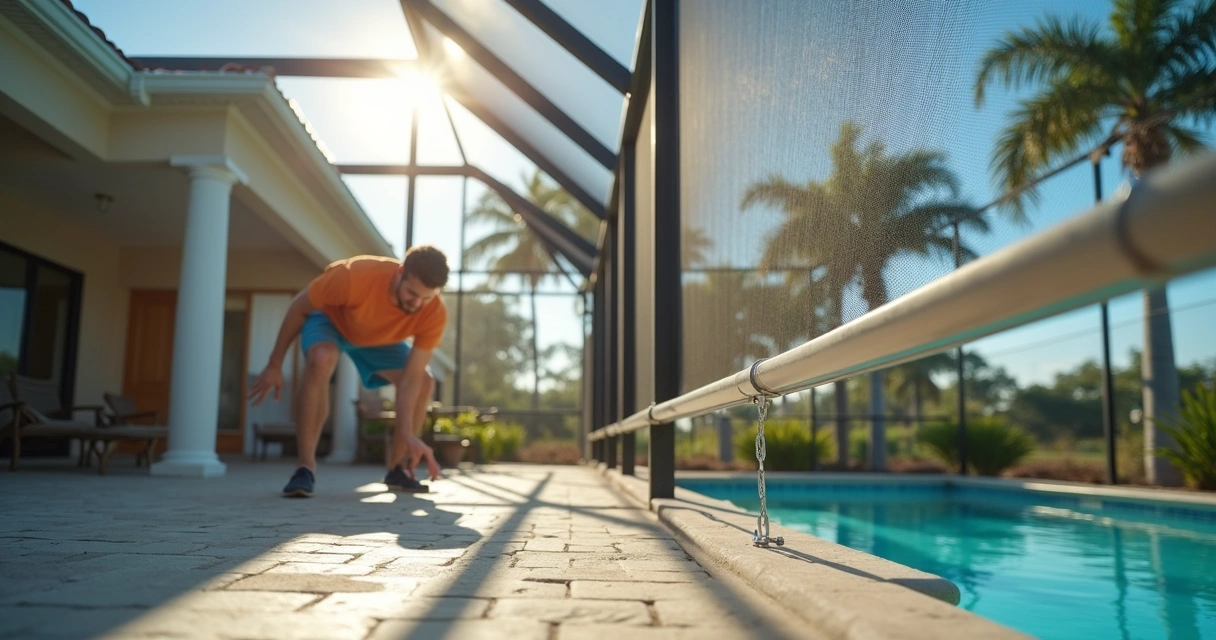
- Panels should be labeled and stored nearby for fast deployment.
- Attachment points are integrated in advance, not drilled in a panic.
- High-quality panels let light in, so the lanai isn’t left fully dark.
The best storm shutter is the one that goes up quickly—before the wind does.
Upgraded doors, latches, and threshold systems
Doors offer both a way in and, during storms, a pathway for weakness. Hinges, latch bolts, sweep seals, and thresholds all matter. We see too many entry doors that rattle, twist, or even blow outwards under pressure.
Our hurricane upgrades include:
- Three-point latching doors (top, middle, bottom)
- Heavy-gauge door frames with extra corner gussets
- Wind-resistant thresholds and sweeps to reduce pressure differences
- Self-closing hinges that snap shut instead of swinging freely
A poorly secured door can let the wind inside, inflating the enclosure like a balloon. Once inside, the pressure can pop off screens or collapse the top rail. The right doors, latches, and seals are a small item with a huge disaster-prevention upside.
Improved engineering for foundations and tie-downs
None of the above upgrades will stand if the entire structure shifts. Older pool cages that sit on thin concrete, shallow anchors, or soft soil may pull loose in hurricane-force winds. Upgrades here mean:
- Deep-driven anchors into structural concrete, at every key post—not just the corners
- Modern footing extensions or “helical tie-downs” for expansive soils like we see throughout Central Florida
- Inclusion of drainage solutions to prevent water undermining the slab (which you can read more about in our hardscape services)
We sometimes meet clients who’ve had a gorgeous enclosure installed, but when we dig at the base, we find half-buried anchors or rusted plates. As storms become more erratic, concrete and underground security matter more than ever.
A strong enclosure deserves a foundation that will not budge.
Making sense of upgrades: do they fit every enclosure?
Sometimes, the answer depends on budget, the age of the structure, or site layout. Maybe the pool deck is narrow, or there’s a complicated paver walk (like those discussed in our driveway and patio projects). Some older enclosures need a rebuild instead of a retrofit. We always start with a careful on-site review to check:
- Soil condition and drainage patterns
- Existing code compliance
- Any HOA requirements or insurance limits
Not every feature needs to be maxed out, but any substantial upgrade means future-proofing investment and reducing future repair needs—which a lot of Florida homeowners worry about.
Integrating upgrades with landscaping and outdoor features
If you’re reworking your yard anyway—maybe adding artificial turf for drainage, or designing a new patio (see our hardscaping gallery)—it’s a smart time to plan enclosure upgrades as part of the project. Foundations may be easier to access, underground tie-downs can integrate with new landscape lighting, and storm panels can be matched with outdoor kitchens or pool features.
Our team always recommends this kind of bundled approach when possible. It’s not just easier for logistics; it means your upgrades never become afterthoughts. In newer projects (like a screened summer kitchen or lanai), everything works together. Space flows cleanly. Details like waterproofing, concrete compacting, or paver transitions are coordinated for longevity.
Maintenance matters: keeping your upgrades hurricane-ready
No upgrade is “set it and forget it.” In our experience, maintenance makes or breaks long-term hurricane resilience:
- Check cable tension and bracket security every spring and fall.
- Look for rust or corrosion at every anchor, lag screw, and hinge.
- Clean debris away from the base—blocked drainage can flood posts, increasing failure risk.
- Re-tension or replace wind panels that have warped or loosened.
Many of these inspections match what state mitigation programs describe as cost-effective, insurance-reducing steps. A little regular care can extend enclosure life by five, ten, even fifteen years—especially when hurricanes keep finding new records to break.
Every enclosure is unique, but so is every family’s peace of mind
We might sound a little cautious. Maybe even a bit obsessive. But, after two decades on Central Florida properties, we’ve realized that one family’s “good enough” is another’s “not safe enough.” Some folks want to match the newest codes; others just wish for the best odds against what next season might bring.
We approach every project with questions, not just answers. What do you use the enclosure for? How do you live in that space? What’s failed or worried you in past storms? Only then do we propose upgrades that fit—not just for wind speed, but for real life here in Florida.
Working with a company that focuses on quality, clear communication, and proven records (that’s what we do at GCM Best Services) gives you not just a more secure enclosure, but a true partner in keeping your outdoor lifestyle safe. Every project begins with a free on-site assessment, and every finish is backed by a written warranty, detailed photos, and a care guide you can trust.
Conclusion
Upgrading a screen enclosure for hurricane season isn’t just about meeting some state standard. It’s about creating real security for your family and your property. With the right framing, bracing, anchors, and panels, your outdoor living spaces stay usable, safe, and protected—no matter what storms roll in. Interested in building for the next season, not just the last one? Contact us at GCM Best Services. We love a good challenge—and we’re ready to help you weather what Florida brings.
Frequently asked questions
What is a hurricane-rated screen enclosure?
A hurricane-rated screen enclosure is designed and built to withstand the high winds and flying debris common in severe storms, especially in Florida.That means meeting specific engineering standards for wind speed (often up to 150 mph in Central Florida), using stronger aluminum frames, reinforced connections, impact-resistant mesh or panels, and corrosion-resistant fasteners. These enclosures must pass stringent structural tests as outlined in modern building codes and often go beyond what was standard twenty years ago. By choosing such an enclosure, you gain much higher protection for your pool, porch, or lanai during hurricane season.
How to strengthen a screen enclosure for hurricanes?
Strengthening a screen enclosure involves adding several key upgrades:
- Reinforce the aluminum framing using thicker or stronger posts and roof beams.
- Install diagonal cable bracing to prevent sideways collapse (“racking”).
- Replace all vulnerable screws/bolts with stainless steel or coated fasteners.
- Add impact-resistant mesh or panels at key locations.
- Install removable storm shutters or panels for high-risk faces.
- Upgrade doors with multi-point latches and strong thresholds.
- Improve the foundation with deeper anchors and proper drainage management.
Regular maintenance and inspections keep these upgrades effective. For the best results, consider a professional evaluation and written estimate from a trusted contractor like GCM Best Services.
What are the best upgrades for hurricane protection?
We’ve found these features offer the strongest boost in hurricane protection:
- High-wind-rated aluminum frames
- Diagonal cable bracing and oversized fasteners
- Stainless steel anchors and corrosion barriers
- Impact-resistant mesh and, where needed, clear polycarbonate panels
- Removable windbreak panels or shutters
- Upgraded doors with three-point locks
- Deep-set footings and drainage improvements
Each upgrade addresses a different failure point—together, they create real resilience.For more technical background, read the Building America Solution Center’s resources or the Florida Division of Emergency Management guidelines.
How much do hurricane upgrades cost?
Costs will vary a lot based on the age, size, and current state of your enclosure. Simple upgrades (like changing out all fasteners for stainless steel, or adding basic cable bracing) may cost from a few hundred to a couple thousand dollars. More involved changes—such as full frame reinforcement, hurricane shutters, or a new impact-resistant door—can run from several thousand dollars up to what a new enclosure would cost, especially if a full rebuild is warranted. We always start with a personalized site assessment and a detailed written estimate. While some upgrades save money on insurance premiums, the biggest value is reducing costly storm repairs in the future.
Is it worth upgrading my screen enclosure?
If you live in Florida (especially near the coast or in hurricane zones), yes, hurricane upgrades are nearly always worth it.Besides the obvious safety and peace of mind, upgrades can lower insurance costs, lengthen the life of your screen enclosure, and prevent expensive storm repairs. If you’re considering selling your home, stronger outdoor features are a selling point. If you love your patio or pool area, upgrades mean you can keep using them for years to come—even as storms keep coming.